




Google's leaked API documentation, two years of core updates, and the rise of AI Overviews have changed what a good backlink means. Links from guest post networks, link exchanges, and paid insertions aren't just less effective than they used to be - many are now a liability.
Meanwhile, every client we work with at the Digital PR Agency who invested consistently in digital PR for SEO has seen their organic authority compound in ways that other tactics simply don't replicate.
Below, I'll explain why that's happening, what Google is rewarding, and how to build a digital PR strategy that moves rankings - based on what we've seen across campaigns in law, e-commerce, SaaS, and regulated industries.
What Is Digital PR for SEO?
Digital PR for SEO is the process of earning editorial coverage, backlinks, and brand mentions from credible online publications. You do it through original research, expert commentary, and newsworthy content, and as a result, build your site's authority in search.
Let’s make it clear from the get-go that it's not the same as link building. Link building chases backlinks through outreach, exchanges, or placement fees. And it's not traditional PR, which targets print and broadcast without an SEO objective.
The distinction that matters for SEO: digital PR earns links that Google's algorithm weights most heavily, because those links come from editorial decisions made by journalists and editors - not from commercial arrangements.
Why Digital PR Matters More for SEO in 2026
The Google API leak changed how we think about link value
The 2024 leak of Google's internal API documentation confirmed what most senior SEOs suspected: link value isn't determined by domain rating alone.
Google analyzes traffic information on the domain and directory levels to calculate the link’s value. A link from a popular section of a large website that gets many visits and updates content all the time will be valued much higher compared to a link from a poorly visited website, despite having equal DRs.
Digital PR agencies targets exactly those environments. That's the point.
AI Overviews have made earned media a direct ranking input
Google's AI Overviews don't just surface results - they synthesize answers from sources they've assessed as credible. Brands that appear consistently in respected publications are more likely to be cited in those answers, because AI systems are trained on the same editorial signals that have always driven PR value.
This matters for SEO beyond just AI visibility. The same authority signals that get your brand into AI Overviews - consistent editorial coverage, expert citations, third-party validation, also feed your traditional organic rankings. They're not separate strategies. They're the same work, with compounding returns.
E-E-A-T is evaluated from the outside in
Google's Search Quality Evaluator Guidelines are explicit about how they assess reputation: they look at what credible third parties say about you, not what you say about yourself. Being cited as a source, quoted in industry publications, or associated with original research all contribute to Google's evaluation of your E-E-A-T (Experience, Expertise, Authoritativeness, Trustworthiness).
On-page optimization can signal expertise. Earned media validates it.
Traditional link building is getting more expensive for less return
Link insertion, broken link building, resource page outreach - none of these are dead, but the cost per link has risen as these tactics have scaled. Everyone is running the same playbooks, using the same tools, and pitching the same webmasters. The links they generate are also increasingly in the low-traffic placements that Google now weights less.
Digital PR for SEO has risen as the credible alternative precisely because the links it generates are the ones Google is trying to reward.
How Google Values Digital PR Links
A few things worth being direct about, because there's a lot of confusion here.
DR is a proxy, not the signal. Domain Rating and Domain Authority are useful for fast screening, but they're not what Google uses. Based on analysis of the leaked API documentation, Google weights links by traffic at the page and folder level, how engaged the audience is, how frequently the section is updated, how relevant the content is to the linking context. A link in a live news article from a mid-sized trade publication with a loyal, active readership can outperform a link from a high-DR site where the linking page gets almost no traffic.
Topical relevance compounds authority. A link from a relevant industry outlet - even a modest one - builds a clearer topical signal than a link from an unrelated high-DR site. We're not just building domain authority; we're telling Google what the site is about. Every placement in a contextually aligned outlet reinforces that.
Nofollow links aren't worthless. Coverage that carries nofollow attributes still builds brand entity recognition, drives referral traffic, and contributes to the reputation signals Google evaluates beyond pure link equity. We don't deprioritize placements just because they're nofollow - we factor in the full value of the coverage.
John Mueller's position on links is often misread. His point is that links will matter less in isolation as Google gets better at evaluating content and entity context. Digital PR generates links plus brand mentions plus topical association - which is exactly the combination that holds value as the algorithm evolves.
The SEO Benefits of Digital PR
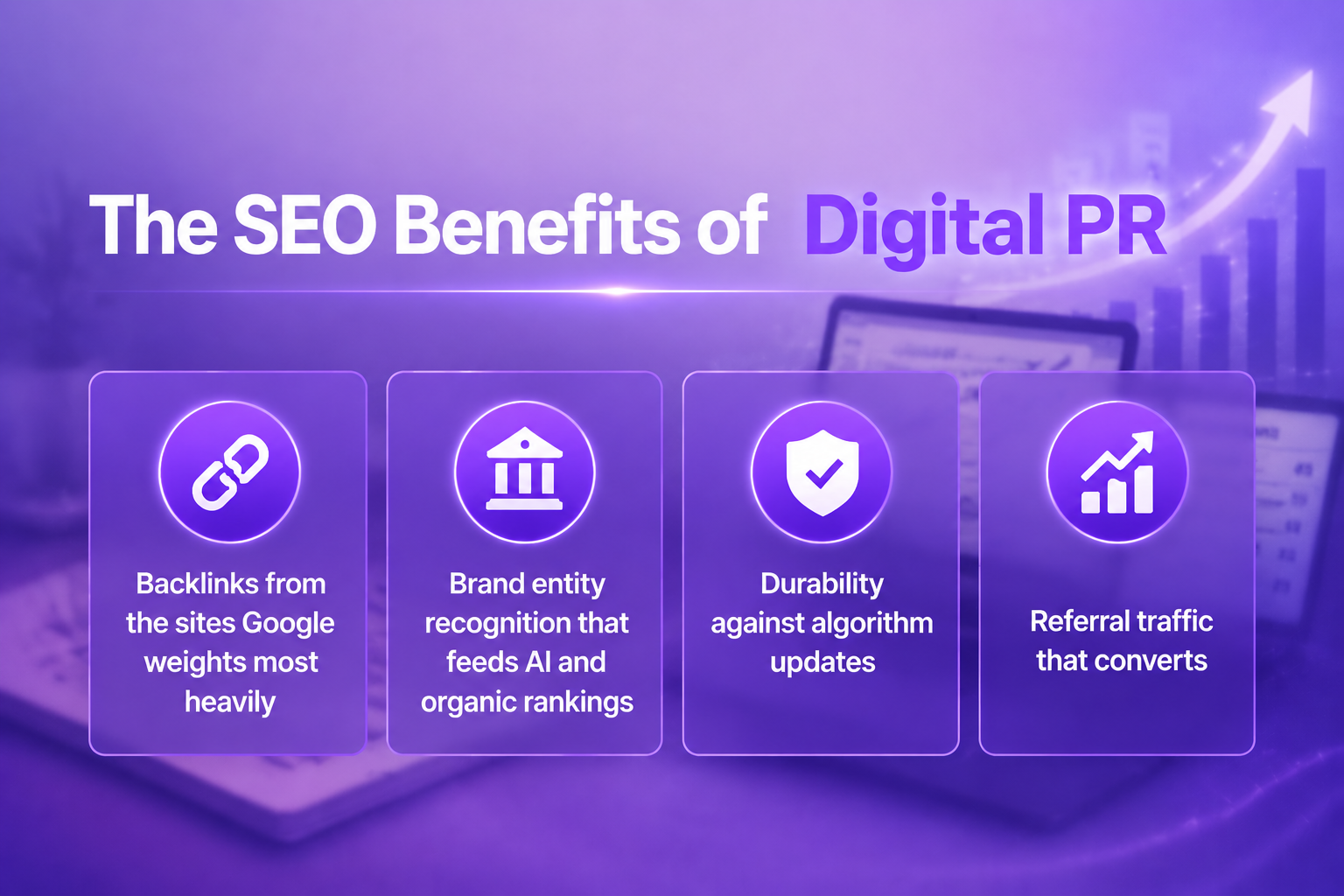
Backlinks from the sites Google weights most heavily
Editorial links from news outlets and respected industry publications are the hardest links to get and the most valuable ones to have. There's no shortcut to them; a journalist has to independently decide your brand is worth writing about.
At The Digital PR, we track DR, estimated page traffic, and topical alignment for every placement we secure. Our campaign average sits consistently above DR 60, with individual placements regularly reaching DR 80-90. When we ran digital PR for an e-commerce brand, the earned backlink profile became the primary driver of category-level ranking improvements within four months.
Brand entity recognition that feeds AI and organic rankings
Search engines, and the AI systems that now power a growing share of search - build their understanding of what a brand represents through repeated co-occurrence in credible sources. Every time your brand appears in a relevant editorial context, it reinforces the association between your name and the topics you want to rank for.
This is how brands get cited in AI-generated answers. Not by optimizing for AI specifically, but by building the kind of editorial presence that AI systems are trained to treat as authoritative.
Durability against algorithm updates
The sites hit hardest by Google's Helpful Content Updates and recent core updates were almost always those with backlink profiles built on manipulation at scale. Digital PR produces the opposite: an entirely earned backlink profile that Google's guidelines explicitly describe as what they're trying to reward.
This isn't immunity. But it means you're not building on a foundation that a policy change or manual action can dismantle.
Referral traffic that converts
A placement in a relevant trade publication sends readers who are already in your market. This is something link insertion and exchange almost never deliver - the referring audience matters, not just the referring domain.
Digital PR Strategies That Move SEO Rankings
1. Original research and data-driven campaigns
Nothing earns editorial coverage or AI citations like a statistic that can't be found anywhere else. When you publish original research, you become the primary source. Journalists cite you. Other publications reference your data. AI systems pull your numbers when answering questions in your space.
The research doesn't need to be a large-scale study. A well-designed survey of 400–500 people on a specific industry question, clearly packaged and distributed, is enough to generate meaningful earned media. What makes it citable: specific statistics (not vague observations), transparent methodology, a strong executive quote that adds context, and a dedicated landing page with schema markup that gives AI systems a permanent reference point.
2. Expert commentary and source building
Platforms like HARO, Qwoted, and Featured connect journalists with subject-matter experts in real time. If someone on your team can respond quickly with a specific, data-backed take - not a generic quote - this is one of the most consistent and scalable digital PR tactics available.
The format that gets picked up and cited is what I call the three-part answer: context, insight, implication. "Supply chain resilience matters for businesses today" is generic and gets ignored. "We're seeing 40% longer lead times across our client base compared to 2022. Businesses that built single-supplier dependencies are now paying for it in stockouts. The ones navigating this well diversified 18 months ago - that window is closing." is specific, citable, and worth quoting. Train your spokespeople to give the second kind of answer.
3. Reactive PR and Newsjacking
When a story breaks in your industry, journalists need expert takes fast. Being the first credible voice with a sharp comment earns you placements in articles already generating traffic.
Speed is the variable. The same insight delivered two days late goes nowhere. This requires a clear internal process for spotting relevant news and getting approved commentary to journalists within hours, not days.
4. Thought Leadership and Op-Eds
A well-argued opinion piece in an industry publication simultaneously builds topical authority and brand recognition. The ones that get referenced challenge a common assumption, or explain something complex in a way that's useful.
Generic thought leadership doesn't move the needle. Specific, opinionated, evidence-backed content does.
How to Run a Digital PR Campaign for SEO
Step 1: Define the SEO objective first. Are you building topical authority in a specific category? Improving domain authority broadly? Supporting specific keyword targets? The objective determines which publications you target, what content you create, and how you measure success. Don't start with a campaign idea and work backward.
Step 2: Identify target publications with the right audience and traffic profile. Look for outlets your audience reads. Then check whether links from those sites correlate with ranking improvements for comparable brands - DR alone isn't sufficient. Prioritize publications with active readership over inflated domain scores.
Step 3: Find the story, not the announcement. Most campaigns fail here. They lead with what the brand wants to say rather than what the journalist needs to write a compelling story. The journalist's question is always: "why would my readers care about this today?" The answer to that is your angle.
Step 4: Build the asset before you pitch. Research report, data visualization, survey findings, well-argued opinion piece - it needs to exist before outreach starts. Journalists don't cover hypotheticals.
Step 5: Pitch specific journalists, not publications. Find who has recently covered adjacent topics. Read their last few pieces. Pitch them a story their audience would want, not a press release about your company.
Step 6: Keep the pitch short and lead with the story. Subject line: communicate the story's value in ten words or fewer. Body: what's new, why it matters to their audience, why now. Three paragraphs maximum. Link to the supporting asset.
Step 7: One follow-up, track everything. A single professional follow-up within five to seven days. For every placement: DR, estimated page traffic, topical alignment, link status, syndication. This data shapes your next campaign.
Digital PR vs Traditional Link Building
Traditional link building is faster to start and easier to scale. The links it generates are also losing value faster than they used to, and the approach carries risk that digital PR doesn't.
We've seen the gap play out directly. When we worked with a law firm - a competitive legal niche where buying links is standard practice - a focused digital PR strategy moved rankings in ways that years of traditional link building hadn't. Read our legal digital PR case for more insight.
The same with a SaaS brand in a competitive B2B space: topical authority built through earned media was the differentiator that generic link building couldn't replicate.
How to Measure Digital PR's SEO Impact
Digital PR isn't difficult to measure, but you need to track the right things. Most agencies report on what's easy to count. We report on the signals that indicate SEO impact.
What we track on every campaign at The Digital PR:
- New referring domains - quantity and DR of placements per campaign
- Estimated page-level traffic of linking pages, not just domain authority
- Topical alignment - how closely each placement maps to target keyword clusters
- Keyword ranking movement in the 60-90 days after a campaign goes live
- Referral traffic by publication - which outlets send engaged visitors
- Branded search volume growth - a rising trend here is a strong indirect signal of growing entity recognition
- AI Overview appearances - whether your brand or content is being surfaced in generative answers
The 60-90 day window matters. Digital PR doesn't produce overnight ranking jumps. What it produces is compounding authority, which is why brands that run it consistently for 6–12 months outperform those that run one campaign and stop.
Final Thoughts on Digital PR for SEO
Digital PR for SEO is the strategy most aligned with where Google's algorithm is heading: rewarding earned editorial authority, brand entity recognition, and third-party validation over manufactured link signals.
The brands ranking at the top of competitive SERPs in 2026 didn't get there by building the most links. They got there by building the most trust - with journalists, with their audience, and with Google's increasingly sophisticated understanding of what a credible source looks like.
If you want to see what this looks like in practice for your industry and you specifically, contact us for a free strategy call.
FAQ
Is digital PR the same as link building?
No. Link building focuses on acquiring backlinks, often at volume. Digital PR for SEO earns links as a by-product of genuine editorial coverage. The links it generates come from third-party editorial decisions, which is exactly what gives them their value with Google's algorithm.
How long does digital PR take to affect SEO rankings?
Most campaigns show measurable ranking movement within 60-90 days of placements going live. Sustained, compounding improvements typically emerge over 6-12 months. It's not a quick fix, but the results hold in ways that link buying doesn't.
Can smaller brands compete with digital PR?
Yes, often more effectively than large brands in a specific niche. A business with genuine expertise in a narrow vertical can dominate expert commentary and data storytelling in that space. Journalists covering that vertical have fewer credible sources, which makes well-executed outreach stand out more, not less.
Does digital PR work without a large budget?
It works if the content and outreach are genuinely good. The main costs are time and quality: producing research worth covering, crafting pitches that earn responses, building journalist relationships over time. See how it played out for a case on a casino brand operating in one of the most restricted niches in digital marketing.
What's the difference between digital PR and traditional PR for SEO?
Traditional PR targets broadcast and print media, where coverage rarely generates backlinks or the brand mentions that feed SEO signals. Digital PR targets online publications specifically, treating each placement as both a brand win and an SEO asset. The outreach looks similar on the surface. The targeting logic and success metrics are completely different.

