




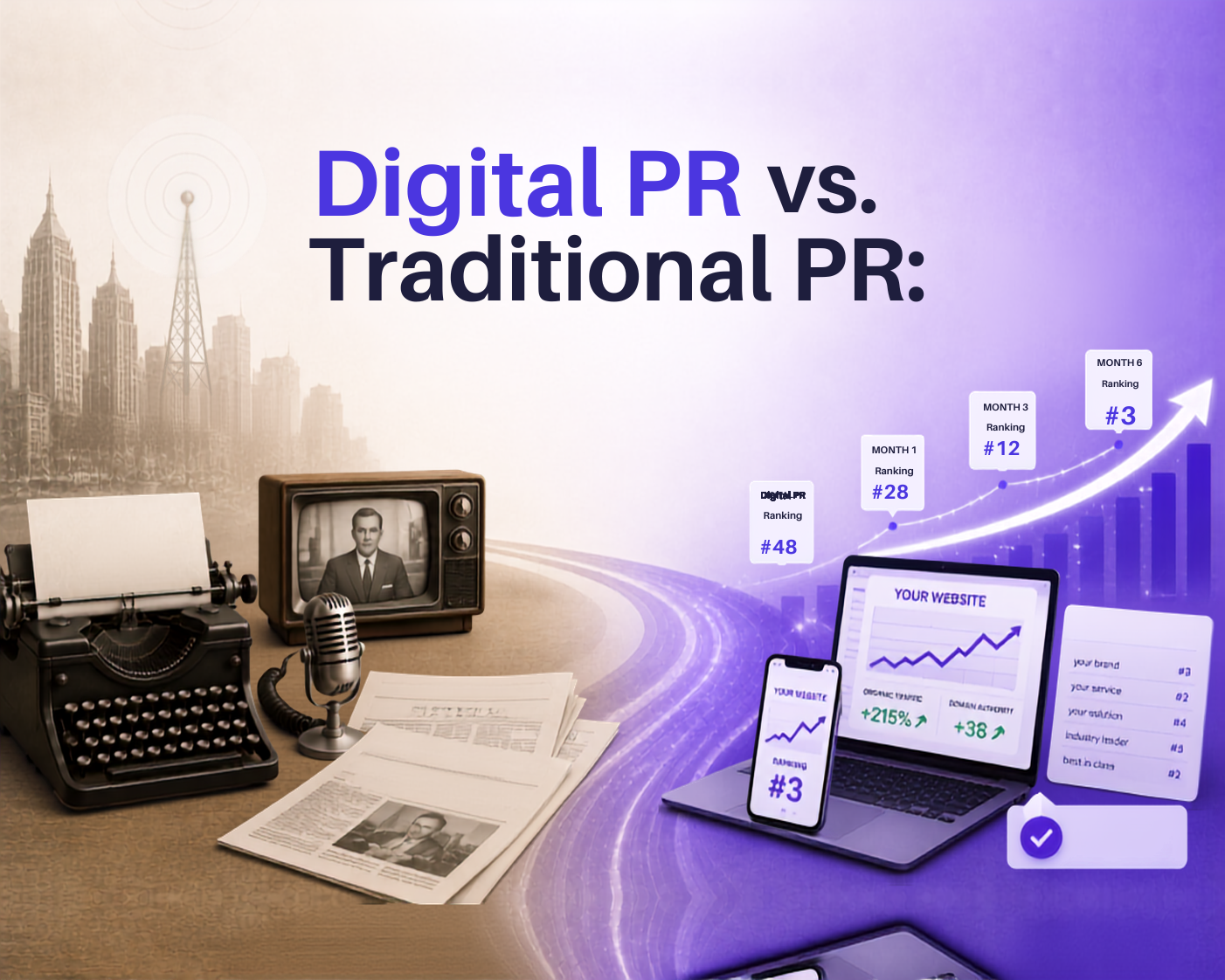
Digital PR vs. Traditional PR: Read This Before You Do Any
The goal of PR has always been the same: make people think well of your brand. What's changed is everything around it - the channels, the metrics, and what "success" actually looks like when the campaign is done.
Traditional and digital PR are not the same discipline wearing different clothes. They behave differently, measure differently, and deliver different things. Here's how to tell them apart and figure out which one you actually need.
Quick Comparison: Traditional PR vs. Digital PR
What Is Traditional PR?
Traditional PR is about getting your story into newspapers, magazines, TV segments, and radio - and doing it by convincing the journalists and editors who control those outlets that you're worth covering.
Core traditional PR channels were and still are:
- National and local newspapers and magazines
- TV news segments, radio interviews, broadcasts
- Billboards and OOH advertising
- Press conferences and trade shows
- Press releases sent to media contacts
The strength of traditional PR is authority.
These methods work because there's something about seeing your story in a respected newspaper or watching a feature on TV that makes it feel credible. For many folks, especially those in certain age groups, industries, and professional settings, there’s nothing quite like this kind of exposure.
The weakness is everything else. You can't easily measure who saw the placement. You can't tell if it drove a single conversion. A print feature can take two months from pitch to publication, by which point your campaign has moved on. And once that newspaper is in the recycling bin, the coverage is effectively gone.
What Is Digital PR?
Digital PR, too, earns coverage, builds credibility, shapes perception - but the playing field is online. You pitch to online journalists, bloggers, podcast hosts, and newsletter editors, and measure success in backlinks, referral traffic, and ranking improvements, not readership estimates.
The numbers you look at shift too; you'd track backlinks, how much traffic you drive from different sites, and improvements in search rankings, not just total readership numbers.
Core digital PR channels are:
- Online news publications and industry media
- Blogs and niche content websites
- Relevant podcasts and YouTube channels
- Organic social media coverage
- Natural influencer partnerships
- Data-driven campaigns designed to earn links
The biggest structural difference between digital and traditional is that digital PR has a direct line to SEO. Every time a high-authority website links back to yours, it signals to Google that your site is trustworthy, which improves your search rankings. That's a compounding return that traditional PR simply cannot deliver.
At the Digital PR Agency, the campaigns we build are designed with this in mind from day one, as we evaluate every placement for domain authority, topical relevance, and link equity.
Traditional PR vs. Digital PR - Differences Broken Down by Important Metrics
Channels
When comparing traditional PR compared to digital PR on channels alone, the gap is stark. Traditional PR is limited to legacy media, such as newspapers, TV stations, and radio networks, in your target market. Digital PR agencies can help you to reach any online publication, anywhere in the world, in any niche.
That matters because niche authority often outperforms general reach. A backlink from a trusted industry blog can do more for your search visibility than a mention in a national paper with no link.
Measurement & Metrics
This is where traditional PR falls short most painfully. The standard metrics are AVE (Advertising Value Equivalent), estimated readership, and circulation figures. These tell you very little about the real impact, so they're more like proxies than proof.
Digital PR gives you real numbers:
- Acquired backlinks - how many, from which domains, and with what anchor text
- DA/DR of linking domains - a measure of how much those links are actually worth
- Referral traffic - real visitors who landed on your site directly from a placement
- Keyword ranking movement - did target pages climb after the campaign ran?
- Share of voice - how often you show up in earned media versus your competitors
- Brand mentions - monitored through tools like Ahrefs, SEMrush, or Mention
We use these metrics with our clients. A law firm needs to know a campaign drove qualified traffic to their practice area pages, not that an article "reached an estimated 200,000 readers." Our law firm case study gets into exactly how that works in practice.
Audience Interaction
Traditional PR is a broadcast. The brand speaks, the audience listens, and there is no feedback loop unless you commission expensive sentiment surveys months later.
Digital PR is a conversation. A placement in an online publication gets shared on LinkedIn. Someone quotes it in a forum. A journalist uses it as a source in their own piece. That one article can generate a chain of secondary coverage and engagement that significantly amplifies the original investment.
This also means your brand is visible in the spaces where buying decisions are actually made. When someone Googles your product category and sees your brand mentioned across five credible sites, that's more than media impression.
Lead Time & Lifespan
A print magazine can take 6-8 weeks from approved creative to publication. A TV segment might be scheduled, delayed, or bumped entirely. Traditional PR requires planning cycles that don't suit fast-moving businesses or responsive campaigns.
Digital PR can move fast. A reactive campaign built around breaking industry news can be pitched, placed, and live within 24-48 hours. For brands that want to newsjack trends or respond to competitor moves, that agility is invaluable.
SEO & Search Visibility
This is the clearest structural advantage digital PR has over traditional, and it's non-negotiable for any brand that cares about organic search.
Google's algorithm is built on links as signals of trust. When authoritative sites link to yours, your domain authority increases, your pages rank higher, and you capture more organic traffic. Traditional PR produces zero backlinks. Digital PR is, among other things, one of the most effective link-building strategies available.
This is why e-commerce brands, SaaS companies, and any business competing in high-traffic search categories should treat digital PR as a core SEO investment. Our ecommerce case and SaaS case both demonstrate how strategic digital PR improves organic visibility in competitive markets.
Credibility & Trust
Traditional PR still wins on perceived authority in certain contexts. A feature in a respected industry journal or a national broadsheet carries institutional weight that a blog post doesn't, especially in sectors like finance, law, and healthcare where audiences are trained to be skeptical of online content.
But "credibility" is increasingly determined by search engine context. When a prospect Googles your brand name and finds coverage across five authoritative online publications, that creates a trust signal that functions the same way a traditional media mention did a decade ago, and it's measurable.
The sweet spot is combining both: traditional coverage for high-stakes credibility moments, digital PR for the steady accumulation of authority signals and search visibility.
Key Stakeholders of Traditional & Digital PR
These two have different professionals and people you’d be working with:
The relationship-building model is different too.
Traditional PR relationships are built slowly, over years, through personal contact. They're high-trust but limited in number - you can only maintain so many genuine journalist relationships.
Digital PR relationships scale differently. A well-executed data study or expert commentary piece can be pitched to hundreds of journalists simultaneously. Basically, the barrier to entry is the quality of your asset.
Can Traditional PR and Digital PR Work Together?
Yes, and most established brands should.
The most effective integrated approach treats them as different layers of the same strategy:
- Traditional PR secures the high-authority placements that build institutional credibility - the kind clients frame on their office walls and quote in investor decks.
- Digital PR amplifies those wins, builds the backlink profile, drives traffic, and generates the data that makes the next campaign smarter.
Consider an example.
A particular brand lands in a popular industry magazine (traditional PR). The digital PR department uses this traditional placement to generate social media posts, share data stories in blogs, and develop a landing page for those keywords the target audience already uses. Thus, a single placement becomes part of a campaign.
It creates an additional loop that is impossible to create with traditional PR. The insights from the digital PR effort (the most shared topics, the sources sending the most referral traffic, and keywords leading to highly-targeted traffic) are helpful for future pitching. Gradually, the strategy is becoming more refined.
In iGaming, for example, the niche where brand credibility and search rankings play equal roles, such a strategy cannot do without digital PR tactics. Our casino case study will show you why.
Traditional PR vs. Digital PR: Which Should You Use?
Use traditional PR if:
- Your target audience is primarily offline (older demographics, regional markets)
- You're in a sector where print/broadcast coverage carries specific regulatory or credibility weight (finance, healthcare, legal)
- You're launching a physical product or running an event-based campaign
- Budget allows for longer-cycle, brand-building activity
Use digital PR if:
- Your customers are online and active on search and social
- SEO and organic traffic are part of your growth strategy
- You need measurable ROI on your PR investment
- You're in a competitive search landscape where backlinks move rankings
- You want campaigns that compound in value over time
Use both if:
- You have the budget, and the audience spans online and offline
- You're a mid-to-large brand building long-term authority
- You want the institutional credibility of traditional media and the search equity of digital placements
However, when it comes to pure measurements of ROI and measurability of PR, digital PR is better for the majority of modern companies.
For all assistance regarding digital PR campaigns, schedule a free consultation with us to discuss how we can take you to new ranks and PR success.
FAQs
Is traditional PR effective in 2026?
Traditional PR is effective in markets with older audiences and when digital media are not fully established yet. Also, TV and newspapers are quite productive if used in regulated industries or where corporate credibility is important. Yes, there are such cases.
What does a digital PR agency do differently?
A digital PR agency has to be competent at creating reports, comments, infographics, and other kinds of creative PR content. It is what publications and high authority websites want to write about or create a backlink if you pitch it properly. And pitching is one of the responsibilities of a digital PR agency.
Besides, the result that they provide impacts your website authority, Google ranks and AI references.
How is digital PR measured?
Digital PR is measured by the number and quality of backlinks you get, referral traffic, keyword ranking movement, and brand mention volume.
You measure these using tools such as Ahrefs, SEMrush, GA4, GEO monitoring, and media monitoring platforms.
What's the average cost of a PR retainer?
For traditional PR, it’s $2,000-20,000+/month. Digital PR typically starts higher, at $5,000-25,000+ per month, and that’s due to the required content production. Campaigns built around original research or data assets push that number up further.
Can small businesses use digital PR?
Absolutely. For small businesses, a well-placed backlink from a high-authority niche publication can be a big victory. You just need to target campaigns in your specific space and sometimes location.
What industries benefit most from digital PR?
Any industry where organic search drives revenue. E-commerce, SaaS, legal, financial services, iGaming, travel, and health tend to see the strongest ROI. But honestly, if you have a website and care about organic growth, there's something here for you.

