

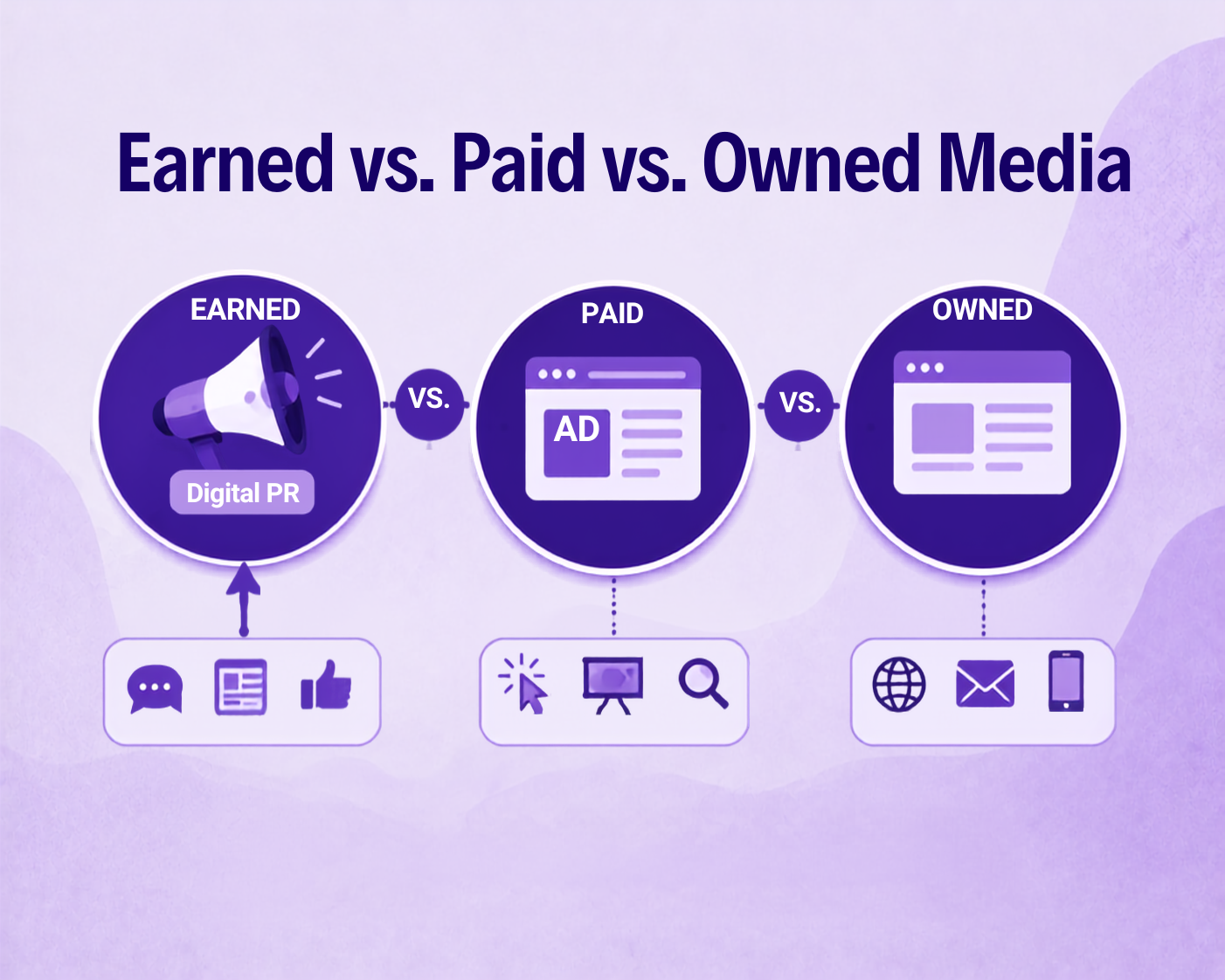
Paid media is what you buy. Owned media is what you control (it’s on your platforms). Earned media is what others say about you without you having to push for it.
Every marketing channel fits under one of those three. Most marketers are comfortable in the first two - digital PR is the work of getting into the third one on purpose.
Now, let me explain how the three differ, where the lines blur, and how digital PR connects them, based on the experience of our digital PR agency.
Paid vs. Owned vs. Earned Media at a Glance
That table is the whole concept in one place. Everything below explains why each row is true.
What Is Paid Media?
Paid media is any exposure you buy. You pay a platform or publisher to put your message in front of a specific audience and get two things in return: speed and control. Your ad runs when you want, says exactly what you want, and reaches whoever you tell it to.
How it's acquired: Through direct payment to a platform, publisher, or network.
Examples: Search ads, social ads, display ads, programmatic ads, influencer sponsorships, sponsored content, TV, print.
Best for: Top-of-funnel awareness and retargeting. Paid is how you get in front of people fast; it's rarely what convinces them to buy.
What Is Owned Media?
Owned media is anything you publish on a channel you control. It's the foundation everything else points back to - your paid ads send traffic to it, and your earned coverage links back to it.
How it's acquired: In-house creation and ongoing maintenance.
Examples: Your website, blog, email newsletter, podcast, app, and the organic posts on your own social profiles (not the ads running through them).
Best for: Mid-funnel nurturing and as the landing point for everything else. Owned media is where paid traffic and earned coverage both need somewhere to go.
What Is Earned Media?
Earned media is coverage, mentions, or links you didn't pay for and don't control - a journalist writes about you, a customer leaves a review, another site links to your research. It exists because someone independently decided you were worth talking about.
How it's acquired: By creating something genuinely worth covering - original research, a strong product, a newsworthy story - and getting it in front of the people who decide what gets published.
Examples: Press coverage, backlinks from news and industry sites, customer reviews, organic social shares, podcast mentions, unprompted influencer posts.
Best for: Bottom-of-funnel trust and validation. By the time someone is comparing you to a competitor, earned media is usually what tips the decision.
Let me show you a concrete example of how this plays out: one of our law firm clients needed to rank for one of the most competitive, expensive terms in legal SEO. Rather than buying links, which is common and risky, in that niche, we built a study from FBI crime data, ranked U.S. cities by crime rate, and pitched it to journalists covering public safety.
The story ran in Yahoo News, MSN, Men's Journal, and 20+ regional outlets, earning 35 backlinks at an average Domain Rating of 77, and moved the firm's target page from page three to position four in eight months. None of that coverage was bought. It was earned because the data gave journalists something genuinely worth publishing.
The Differences That Matter
Control
Owned media gives you full control. Paid media gives you near-full control, capped by budget. Earned media gives you none - you can influence the odds of coverage by building the right relationships and the right story, but you can't dictate the headline, the angle, or whether a journalist says yes.
Cost
Paid media has a direct, visible cost: you know exactly what a click or an impression costs you. The cost of owned media is mostly time and production - content doesn't buy itself, but there's no media spend line item.
Earned media's cost is the least visible of the three: it's the research, the pitching, and the journalist relationships that sit behind a placement, which is why "earned media is free" is one of the more misleading phrases in marketing.
Credibility
This is where earned media wins outright. A recommendation from an independent source carries more weight than a brand's own claim, because the audience knows the brand didn't write it. Owned media earns credibility slowly, through consistency. Paid media earns the least, by default, though it can borrow credibility from the channel it runs on.
Speed vs. Sustainability
Paid is fast and disappears the moment you stop spending. Owned is slow to build but keeps compounding as long as you maintain it. Earned is the least predictable in timing; a pitch might land in two days or never, but a strong placement keeps sending traffic and authority signals for years after the news cycle moves on.
Funnel Alignment
Paid media is most efficient at the top of the funnel, driving awareness fast. Owned media works the middle, educating and nurturing people who are already somewhat interested. Earned media does its heaviest lifting at the bottom, validating a decision someone's already close to making.
Is It Paid, Owned, or Earned? Quick Classification
The reason this topic causes confusion is that most modern channels can be all three, depending on who's behind the activity. Here's how the most commonly confused channels break down:
Where Does Digital PR Fit In Earned vs. Paid vs. Owned Media?
Digital PR is the discipline that deliberately, repeatedly, and at a scale converts owned assets into earned coverage.
The loop looks like this:
- You build something on an owned channel (a data study, a report, a landing page),
- Pitch it to journalists as a story worth covering,
- Earn coverage and backlinks when they publish it,
- Amplify that coverage back through your owned channels and, often, paid promotion.
Each pass through the loop reinforces the other two media types instead of competing with them.
Two clarifications worth making explicitly, because they're the most common points of confusion:
Digital PR isn't traditional PR with a website attached. You can rarely measure the results of traditional PR (print, TV, radio). But digital PR can and is measured for its SEO and brand awareness results using backlinks, traffic numbers, ranking impact, and more.
Digital PR isn't link building either. The goal of link building is the link. Digital PR's goal is the story; the link is a byproduct of a journalist deciding your content is worth citing. That distinction is why digital PR links tend to come from good, authoritative pages.
Digital PR for Regulated and High-Scrutiny Industries
Not every niche can earn coverage the same way. iGaming and casino brands face strict regulations, intense competition, and mainstream publishers that avoid gambling-adjacent links outright. That’s exactly the kind of environment where pure paid media (ad platforms restrict gambling spend heavily) and pure owned media (limited reach without external amplification) both hit a ceiling.
For one casino client, we conducted a reliability study testing 10 major AI chatbots - the surprising finding was that ChatGPT, the most-used tool, ranked the least reliable for accuracy, while Grok ranked near the top. The story earned 67 links and mentions across 10+ countries, including a share from Elon Musk himself, without touching a single paid placement. That's earned media (digital PR for iGaming in this case) working in a sector where most growth channels are restricted by design.
How to Measure Each Media Type
Each media type needs a different scorecard:
We track this last one for every campaign now because referral traffic alone undersells what a placement does for a brand's visibility.
Key Takeaway: How the Three Work Together
No brand should run on just one of these. A simple example shows why:
A startup runs search ads to drive traffic to its product page. That's paid. The page itself lives on their site, with copy and testimonials they control entirely. That's owned. A journalist stumbles across the product, writes about it independently, and links back. That's earned. None of it happens in isolation. Each type feeds the next:
- Paid media creates initial visibility
- Owned media gives that visibility a credible place to land
- Earned media validates the decision for everyone who arrives afterward
This three-part structure is sometimes extended into the PESO model (Paid, Earned, Shared, Owned), where "shared" - social reposts, forwards, and word-of-mouth - sits as a hybrid of earned and owned depending on who's doing the sharing.
If you're trying to build earned media on purpose rather than hoping it happens, that's the work we do every day. See some of our digital PR campaigns in our case studies, or get a free strategy call to discuss opportunities for your specific case.
FAQ
What is the POEM model?
POEM stands for Paid, Owned, and Earned Media - the same framework this article covers, sometimes extended to PESO when "shared" media is broken out as its own category.
Is earned media really free?
No. The coverage itself doesn't cost a media-buy fee, but the research, content creation, and journalist outreach behind a placement take real time and skill. "Free" applies to the line item, not the effort.
What should come first: paid, owned, or earned media?
Owned, generally - you need somewhere credible for paid traffic to land and for earned coverage to link back to. After that, most brands run paid and earned in parallel: paid for immediate visibility while earned media builds over a longer timeline.
Is digital PR the same as earned media?
Digital PR is a specific, SEO- and AI-focused way of generating earned media. All digital PR produces earned media; not all earned media comes from a digital PR strategy - a viral customer review, for instance, is earned but isn't digital PR.

