




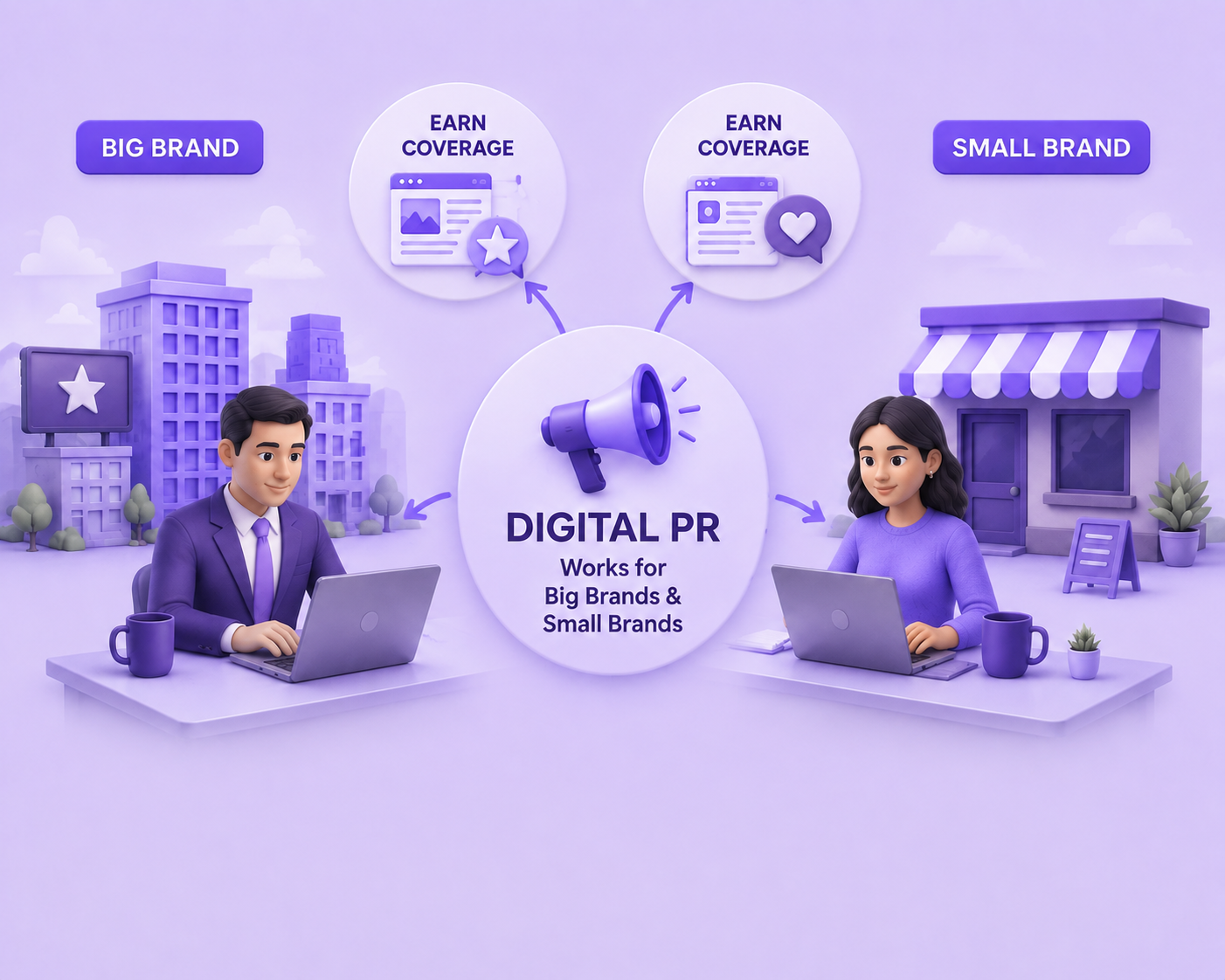
No, digital PR is not only for big brands. Small and mid-sized businesses use it every day to earn backlinks, build local or niche authority, and get cited in AI search results, without national ad budgets or in-house PR teams.
The idea that digital PR is reserved for enterprise companies stops good businesses from trying a channel that, done right, is one of the most cost-effective ways to build authority online.
Below, I'll break down exactly why that belief exists, how small brands run digital PR campaigns, what they cost, and a real example of a boutique firm that out-earned national competitors for backlinks without a national budget.
If you're still asking what is digital PR in the first place, start there - this post assumes you know the basics and want the honest answer to "can my business do this?"
Why People Assume Digital PR Is Only for Big Brands
The misconception isn't irrational. A few things reinforce it:
- Visible case studies skew big. The campaigns that go viral on LinkedIn or get written up as "best digital PR campaigns of the year" tend to be national brands with six-figure budgets, because those are the stories agencies like to showcase.
- Big PR agencies market to big companies. Search "digital PR agency" and most of what you'll see is enterprise-focused pricing and retainers, which makes the whole category feel out of reach.
- Small businesses conflate digital PR with mass-media coverage. They picture landing on the front page of Forbes and assume that's the bar, when in reality, a single well-placed link from a relevant trade publication or regional outlet can do more for a small brand's SEO than a mention in a huge outlet with zero topical relevance.
- Digital PR gets confused with link building. Some businesses think of digital PR purely as buying or acquiring links at scale, which does sound like something only bigger budgets can sustain. It isn't. If you want the real distinction, I've written in detail about digital PR vs. link building.
None of that changes what digital PR is: a strategy for earning coverage and links through newsworthy stories, data, and expertise. Budget size doesn't gate access to that.
How Small Businesses Use Digital PR
Small and mid-sized brands don't run digital PR the same way a national retailer does, and they shouldn't try to. The approach that works at small scale looks different:
Local and Niche Targeting Instead of National Reach
A small business doesn't need to be in USA Today. It needs to be in the outlets its customers and prospects read - local news sites, regional business press, and industry-specific publications. These are far easier to break into and often more valuable for both SEO relevance and referral traffic.
Founder-Led Thought Leadership Instead of Big-Budget Campaigns
When there's no in-house PR department, the founder or a senior expert becomes the story. Journalists want credible commentary and a founder who genuinely knows their industry is a more compelling source than a generic company statement.
Small First-Party Data Instead of Expensive Research Studies
You don't need a market research firm. A modest survey of your own customers, a dataset pulled from your own operations, or - as we'll get into below - a public dataset analyzed through the lens of your expertise can be enough to earn coverage.
Trade and Industry Blogs Instead of Major Mastheads
A backlink from a well-regarded niche publication in your industry often carries more topical relevance (and search value) than a generic mention in a huge outlet that has nothing to do with what you sell.
Big Brands vs. Small Brands: How the Approach Differs
The mechanics - pitching a story, earning a link, building topical authority - are identical.
What Digital PR Costs for a Small Business
This is usually the real question behind "is digital PR only for big brands," so let's answer it directly. Small businesses typically run digital PR in one of two ways:
- Project-based campaigns - a single data-driven story or asset pitched to a defined list of publications, often in the range of a few thousand dollars for the full cycle: research, content, design, and outreach.
- Ongoing retainers at a smaller scale - monthly digital PR support focused on a narrower set of publications and a slower, steadier cadence of coverage, generally far below what national campaigns cost, because the outreach list and content production are both smaller in scope.
When working with small- to medium-sized businesses, for example, we start at $1,300 per month for a minimum of 3 months of work, because digital PR results compound over weeks. This includes unlimited campaigns to hit your link target, digital PR for full GEO and AI search optimization, and a lot more. So, look for digital PR companies that will break down exactly what you will get for the price you pay.
A Small Brand Example: How a 10-Person Law Firm Out-Earned National Competitors
Instead of explaining everything in abstract terms, let me give you an example from our digital PR agency.
The business was a boutique criminal defense firm in Las Vegas with fewer than 10 employees, trying to rank for "criminal defense lawyer in Las Vegas" - one of the most competitive and expensive keyword spaces in the legal industry, dominated by large firms with far bigger ad budgets.
Outspending established, national-level competitors on paid ads wasn't realistic. Local SEO alone would take too long to do anything. So, instead of trying to out-advertise bigger firms, the team leaned into the firm's existing subject-matter authority.
Criminal defense and public safety were already core to what the firm does, so instead of talking only about Las Vegas, we analyzed raw FBI crime data across major U.S. cities and built a clean, ranked breakdown of where crime was rising fastest.
That single dataset gave journalists three things they need to say yes to a pitch:
- Inherent relevance - crime and public safety sit at the intersection of law, news, and everyday life, so it's a natural story for a wide range of outlets.
- Instant credibility - the data came from the FBI, so editors didn't need to spend time independently verifying it.
- Built-in headlines - the rankings gave editors a ready-made hook (cities like Memphis, St. Louis, and Detroit topping the list), which meant less editorial work to turn it into a story.
The team then split the pitch: a national angle around the full leaderboard, and localized versions of the same data for regional editors in cities like Miami, Sacramento, and Charlotte, each showing what was happening in their own backyard. Same underlying dataset, different hook depending on the audience.
The results were truly phenomenal. In a few weeks, we managed to get 35 high-authority backlinks, including placements in
- Men's Journal (DR 85, 15M+ monthly readers),
- Miami Herald (DR 87, 3.6M+ monthly readers),
- Sacramento Bee (DR 85, 1.5M+ monthly readers),
- MSN (DR 92), and
- Yahoo News (DR 94)
These are outlets with combined monthly reach in the billions!
Why Digital PR Worked for a Small Brand Specifically?
A firm with fewer than 10 employees ended up with a backlink profile (DR 70-94 range) that rivals what national conglomerates spend heavily to build. All it required was a specific angle, credible data, and a willingness to slice that data in ways that were locally relevant to dozens of different editors.
That's the "David vs. Goliath" mechanic at the heart of digital PR: journalists don't care about your headcount; they care about whether your story is good enough to run.
There's also a quieter effect worth naming: when a prospective client in Las Vegas sees a boutique firm cited in Men's Journal, MSN, and Yahoo News, the trust dynamic shifts instantly. That firm now reads as the top-tier option in its market, not the underdog - which is a brand-building effect of digital PR.
How to Start: A Realistic Process for Small Brands
You don't need a big team to run a campaign like the one above. You need a clear process:
- Pick one niche or local angle you can credibly own. Don't try to be relevant to everyone - choose the specific topic where your business already has real expertise.
- Build a realistic target list. Skip the dream list of top-tier national outlets and start with 15-20 publications that would genuinely care about your angle - trade press, regional outlets, niche blogs.
- Create one asset worth citing. This can be a small survey, an analysis of public data (like the FBI dataset above), or a sharp expert take on something already in the news. It needs one clear, quotable finding.
- Pitch directly and specifically. Tailor each pitch to the publication and the journalist, not a mass blast. Localize the same core story for different regional audiences where relevant, the way the FBI dataset was reworked city by city.
- Track mentions and links. A handful of relevant, high-authority links will outperform a large volume of low-quality ones. For a full breakdown of what to track, see how to measure your digital PR campaign’s results.
Key Takeaway
Digital PR isn't gated by company size. It's gated by whether you have a story worth telling and the discipline to pitch it well. If you want help figuring out that angle for your business, the Digital PR Agency works with brands of every size to build campaigns like the one above - including specialized work like our iGaming, legal, SaaS, adults, and other niche industries that need targeted authority. Jump into a free strategy call with us, and let’s plan your campaign.
Frequently Asked Questions
Do small businesses need digital PR?
Not every small business needs it immediately, but any business trying to build organic visibility, backlinks, or credibility in a competitive market benefits from it. It's often more cost-effective than paid ads over time, especially in competitive local or niche markets.
How is digital PR different from traditional PR for a small business?
Traditional PR focuses on print, broadcast, and offline reputation management, which is often slower and harder to measure. Digital PR is built around online coverage, backlinks, and measurable engagement - a better fit for most small businesses' budgets and goals. Full comparison here: digital PR vs. traditional PR.
Can a small business run digital PR without a big team?
Yes. Many small brands run it with a founder or a single marketing lead handling strategy, and either an outside agency or a freelance specialist handling outreach and content. The Spartacus example above was executed by a lean team, not an internal PR department.
What results should a small business expect, and by when?
Early coverage and links may appear within 1-3 months. The compounding SEO impact - better rankings, more organic traffic - usually builds over 3-6 months as backlinks accumulate authority.

