




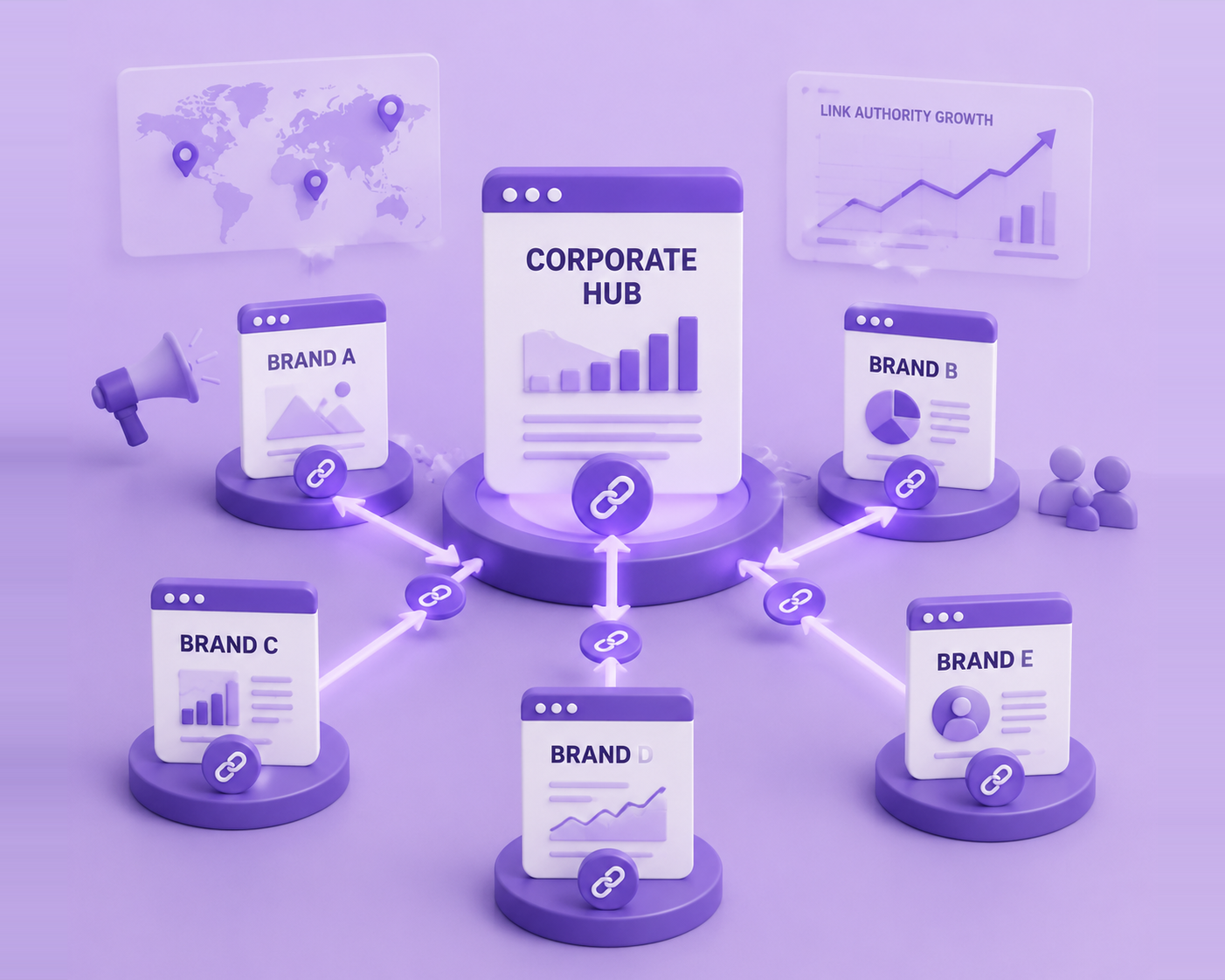
Link building across a portfolio of brands is harder than it looks because the coordination changes. Get it wrong, and your brands compete against each other, dilute each other's authority, or trigger spam signals you didn't see coming.
This guide covers the foundational decisions you need to make before any outreach starts, how to execute across multiple brands without creating those problems, and how to govern and measure the whole thing as it scales.
Two Problems That Make Multi-Brand Portfolio Link Building Different
Most link building advice assumes one domain. Managing several brands introduces two problems most teams don't catch until the damage is done.
Authority dilution. Link authority belongs to a domain, not the company behind it. Five brands building links separately don't combine into one strong profile - they produce five weak ones, each competing against a single competitor who put the same effort into one domain.
Keyword cannibalization. Two brands targeting the same terms split the traffic instead of one brand dominating the result. This usually goes unnoticed until rankings start behaving strangely and someone finally maps out the overlap.
Both problems have the same fix: sort out the structure before any outreach starts. Everything else in this guide sits on top of that foundation.
Before Anything Else: Match Your Link Building Strategy to Your Portfolio Type
"Multi-brand portfolio" means different things to different businesses, and the right approach depends entirely on which type you're running.
Holding company with unrelated brands - the brands share an owner but serve completely different audiences and categories. Almost no coordination is needed at the link building level, and forcing it creates more problems than it solves.
Tiered sub-brands sharing a customer base - brands that serve the same audience at different price points, feature levels, or life stages. Tight coordination is required here because keyword cannibalization and shared reputation risk are both live problems.
Franchise or multi-location brand - the same brand identity appearing in multiple geographies. This is closer to a local SEO problem than a portfolio link building problem, and most of what follows applies only partially.
Agency managing multiple client brands - the coordination challenge is governance and process rather than authority consolidation. The section on centralized versus decentralized models is your priority.
Know which one applies before reading further. The tactics are the same; the emphasis shifts significantly depending on the answer.
Domain Architecture for Multi-Brand SEO: Which Structure Protects Link Equity
Your domain architecture decides whether the links you earn for one brand can ever help another. This has to get settled before any
Cross-Brand Internal Linking: What's Safe and What Triggers a Penalty
Once you've settled the architecture, the natural follow-up question is what you're allowed to do with cross-brand links. Google doesn't have a rule that singles out commonly-owned domains by name. What gets penalized is intent and pattern: links built to manipulate rankings rather than help an actual reader, regardless of who owns the sites on either end.
What's fine: Editorial mentions with a genuine reason to exist - a value brand referencing its premium sister in a price-tier comparison, a corporate hub linking its properties, sister brands citing a shared study with their own commentary.
What gets flagged: Site-wide footer or nav link blocks across owned domains. Reciprocal linking at scale. Identical commercial anchor text pushed from every brand at once. A sudden, correlated burst of link activity across owned domains.
The test: Would you delete the link if Google disappeared? Then it's a scheme. A footer block across five owned domains has no editorial reason to exist. A sister brand is mentioned inside real coverage.
Why Digital PR Outperforms Traditional Link Building at Portfolio Scale
Traditional link building is a repetitive operation: one domain, one webmaster, one placement. More volume is just more of the same thing running in parallel.
Compared to traditional link building, Digital PR compounds. One well-built asset - original data, a counterintuitive finding, commentary a journalist actually wants - earns links across multiple brands simultaneously, depending on how you route outreach. Authority flows portfolio-wide through internal linking. Brand mentions in AI systems apply to every property, not just the one named in the press release.
Link quality compounds, too. Google weights links by the traffic of the page they appear on, not just domain DR. Editorial placements in active publications outperform negotiated insertions on dead resource pages, and that quality gap multiplies across every brand in the portfolio.
Run both if the budget allows. But digital PR is the one that doesn't get harder as the portfolio grows.
The Parent-Child Authority Model: How to Let Corporate Link Equity Flow to Sub-Brands
Trying to get every brand covered in national press is expensive and slow. The parent-child model skips that: the corporate domain earns the hard press hits, then routes authority down to individual brands. One story does the work for several brands at once.
What belongs at the corporate level are stories too broad for any single brand - an industry-wide study, a proprietary data report journalists from different beats can cite, executive commentary on market conditions. These sit at the parent domain because they're about the space the whole portfolio operates in.
How it works in practice: the parent publishes an original study with a real finding and transparent methodology. The pitch is the data, not any sub-brand. Coverage links to the parent's study page; internal links route authority to each relevant brand hub; sister brands reference the study with their own added commentary, not a re-embedded link.
Pitching corporate assets is often easier than brand pitches because you're not asking a journalist to write about a company - you're giving them something worth reporting. Brand attribution comes naturally when they identify the source of the research.
One hard caveat: this only works if the corporate hub is actively maintained. A newsroom with three press releases from 2022 routes nothing. The model compounds on sites with a live, frequently updated news section where high-authority links stay fresh and get regularly indexed.
Build One Digital PR Asset, Earn Backlinks Across Multiple Brands
One well-built data asset can earn links for several brands simultaneously, the highest-leverage tactic in this guide.
Decide upfront which brand page each outreach effort points to, based on topical relevance, not on which brand team asked first!
Segment by audience tier. For a law firm competing on one of legal search's most competitive terms, we built an FBI crime data study and pitched it two ways: national outlets got the full city-by-city ranking, and regional papers got their local slice. Same dataset, two angles, 35 backlinks at an average DR of 77. The firm moved from page 3 to position 4 in eight months. A shared portfolio asset routes the same way - one campaign covers ground that would otherwise take several separate pitches.
Go off-topic to expand reach. For a casino client, we built a reliability study scoring ten AI chatbots on hallucination rate, downtime, and consistency - ChatGPT scored the least reliable, a less obvious name scored near the top. Nothing to do with gambling, which is exactly why it worked: 67 links across tech, AI, and crypto coverage in ten-plus countries, plus a share from Elon Musk on X. Reach a gambling-specific pitch never would have touched. A portfolio spanning a casino brand, a fintech brand, and a consumer app could route that single story to all three, rather than running three separate campaigns.
Preventing Backlink Profile Overlap Across Portfolio Brands
Shared assets create efficiency - they shouldn't create identical backlink profiles.
Run competitive analysis for each brand against its own direct rivals, not the portfolio's combined competitor set. Portfolio-wide averages bury brand-specific gaps.
Some gaps run deeper than different keywords. An iGaming brand operates under constraints that an ecommerce or SaaS brand never sees: restrictions on what can be published and where, publishers who won't touch gambling-adjacent content regardless of quality, and a higher bar for proving a placement is safe. Its media list, angles, and compliance review look nothing like what works for a law firm or SaaS brand in the same portfolio.
Centralized assets build shared authority. Brand-level outreach still needs to match each brand's competitive landscape, niche publishers, and acceptable content types.
How to Reclaim Unlinked Brand Mentions Across a Multi-Brand Portfolio
Set up brand monitoring for every name in the portfolio in one consolidated stack, not five separate alerts that each brand team manages independently. Siloed setups miss sister-brand mentions.
Tools like Google Alerts, Mention, Meltwater, or Brand24 can track every brand simultaneously. Prioritize by authority: high-DR unlinked mentions first. The conversion rate for "you already wrote about us, can you add the link?" consistently beats cold outreach. Campaigns like the chatbot study above tend to generate a wave of unlinked pickups in the days after launch - portfolio-wide monitoring catches them before they go stale.
Once the stack is in place, this requires almost no additional effort.
Centralized vs. Decentralized Link Building: The Right Model for Multi-Brand Portfolios
Fully centralized is efficient, but flattens every brand's voice until pitches sound identical. Fully decentralized keeps voices authentic, but duplicates vendor relationships and lets cannibalization creep back in.
Hybrid is the realistic default: centralize PR relationships, tooling, and shared-asset production; decentralize niche targeting and pitch voice. Explicitly decide who has the final say on cross-brand link placements before a disagreement forces a decision under pressure.
In practice: run a focused link building motion to hold rankings on bottom-of-funnel pages in parallel with a digital PR campaign building brand authority. Neither replaces the other. Scale that logic across the portfolio - centralize asset production, decentralize brand-level link building, run both continuously.
How to Measure Link Building Performance Across Multiple Brands
Track one dashboard for the portfolio and a separate scorecard for each brand. Collapsing them into a single view hides exactly the cannibalization risk described earlier.
At the portfolio level: aggregate referring domains, portfolio-wide DR growth, link velocity, and share of voice against competitors as a group.
At the brand level: brand-specific referring domains, branded-versus-unbranded anchor mix, and gap closure against that brand's own rivals specifically.
For a benchmark, campaigns built around genuine editorial coverage tend to average above DR 60, with individual placements regularly landing in the 80s and 90s - useful context for judging whether a brand-level campaign is performing or just generating volume.
Pick a platform with real multi-property views rather than juggling five separate logins. The extra friction of switching between accounts is exactly what causes teams to collapse the two altitudes into one and lose sight of brand-level gaps.
For more technical, in-depth information, read our guide to measuring digital PR.
The Mistakes That Quietly Kill Multi-Brand Link Building Campaigns
- Press releases are the primary vehicle. A product update announcement gives journalists nothing to cover. Original data with a counterintuitive finding does.
- Correlated link velocity across owned domains. Simultaneous spikes across several brands read as coordinated. Stagger campaigns; don't let shared asset launches create simultaneous footprints.
- Over-centralizing until every brand sounds identical. Centralize asset production while keeping each brand's outreach voice distinct. Generic pitches to generic media lists get ignored.
- Chasing DR over relevance. A topically perfect lower-DR placement usually outperforms a high-DR one with no editorial fit. Context matters more than the metric.
- Copy-paste the same strategy across every brand. Competitive landscapes, content types, and niche publishers vary by brand. Applying one playbook everywhere generates activity with no ranking movement.
How Digital PR and Link Building Affect AI Search Visibility Across a Portfolio
Yes, link building and digital PR particularly affect AI search. AI engines cite brands with consistent, credible earned coverage - the same mechanism as SEO, measured differently. Repeated co-occurrence of a brand with a topic in credible outlets is how AI systems build associations. One of our ecommerce clients went from zero to 31 ChatGPT citations on its target terms after consistent placements in Cosmopolitan and Marie Claire.
The portfolio advantage occurs when several related brands earn relevant coverage simultaneously; AI systems associate the whole group with the category, not just the brand that ran the most recent campaign.
A single brand can't generate that. The corporate asset strategy isn't just building SEO authority; it's building the pattern of editorial co-occurrence that AI citation systems are trained to surface.
Key Takeaway: Start With Portfolio Architecture Before Scaling Link Building Outreach
Multi-brand link building is, first and foremost, a coordination problem. Get the architecture and governance in place, then the tactics compound the way they're supposed to.
If you want to map out where your portfolio's strategy should start, take a look at how we approach digital PR and get in touch. We'll review what's already running across your brands and identify the highest-leverage move from there.
Frequently Asked Questions
How long until a multi-brand link building campaign shows results?
Individual placements go live within two to six weeks. Ranking movement takes eight weeks to eight months, depending on competitiveness. Full portfolio-wide compounding is a six- to twelve-month runway. Judge against that, not against one brand's earliest numbers.
Can sister brands link to each other in the footer or navigation?
No. Site-wide links across owned domains are exactly what link spam systems are built to catch. Keep cross-brand links contextual, inside content, with a genuine editorial reason to exist.
How should the link building budget be split between the corporate parent and individual brands?
Most of it goes to brand-specific outreach run against each brand's own competitors. The corporate parent needs enough to maintain a link-worthy hub and produce shared assets — not its own parallel outreach campaign.
Is this the same as local citation building for multi-location businesses?
No. Local citations verify a business's name, address, and phone number for local pack rankings. Portfolio link building earns authority and editorial coverage across distinct brand identities. Different mechanism, different problem.
What's the practical difference between digital PR and traditional link building for a portfolio?
Traditional link building places links through direct outreach - a webmaster agrees, and the link goes live. Digital PR earns coverage because a journalist independently decided the content was worth citing. For a portfolio, that distinction is structural: one digital PR asset can generate links for multiple brands simultaneously, build parent-domain authority, and create AI entity associations portfolio-wide. Traditional link building is one placement at a time, by design.

