




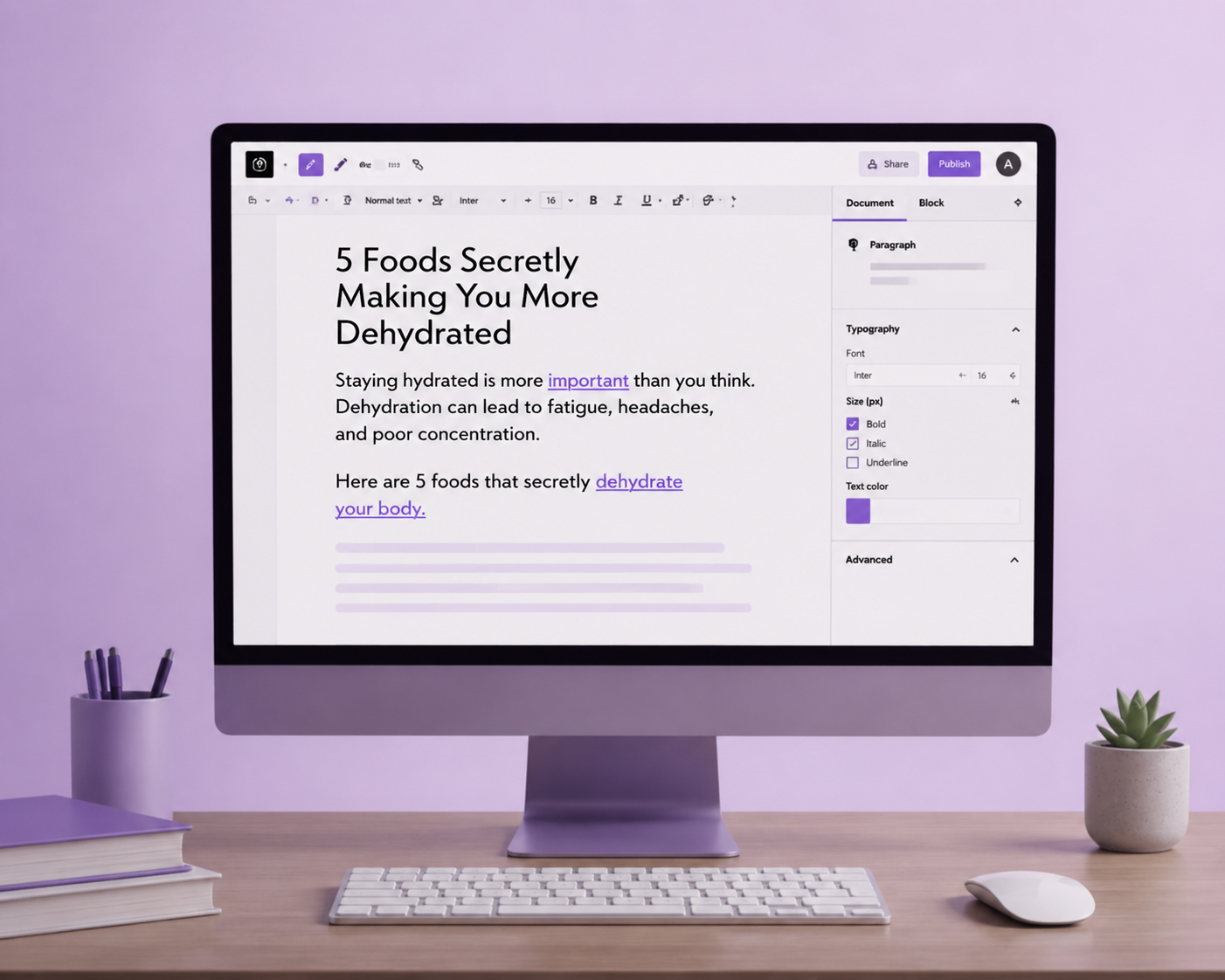
Anchor text is the clickable text inside a hyperlink - the words a reader sees and clicks, and the words search engines and AI systems read to understand what the linked page is about.
That's the whole concept. Everything else in this guide is about doing it well, specifically for digital PR.
I write this from within a digital PR agency, so many of the best practices I share come from analyzing hundreds of earned media placements. We’ve seen firsthand which anchor text patterns tend to support rankings and growth of digital PR campaigns and which ones can raise red flags with Google.
Anchor Text Best Practices, in Five Rules
If you only read one section, read this one.
- Be descriptive. Someone should be able to understand where a link goes from the anchor text alone, without any surrounding sentence.
- Be short. Five words or fewer, almost always. A linked sentence is a design failure, not a strategy.
- Match the surrounding sentence. Don't bend grammar to fit a keyword into the link.
- Make it visually obvious. Underline it, color it, do something that says "this is clickable" before the reader even reads the words.
- Vary it. Linking to the same page from five different articles should not produce five identical anchors.
The rest of this guide is the reasoning behind each of those, plus how much of each type you should use.
Types of Anchor Text (With Real Examples)
There are six types of anchor texts you should know. Everything else you'll see floating around ("related keywords," "title match") is a flavor of one of these six.
Two things worth noticing in this table.
First, branded anchor text is what editorial coverage defaults to almost automatically - when journalists in five different countries covered our ecommerce client's research, nearly every outlet linked using the brand name itself, not a keyword phrase, simply because that's how people write when they're not thinking about SEO or digital PR.
Second, generic anchor text isn't always wrong - it's wrong when it's doing the only descriptive work in the sentence. "You can read the full methodology here" is fine (linking the underlined part), because "full methodology" already told you what's behind the link.
The Ideal Anchor Text Ratio
Google has never published a ratio for anchor text, and anyone telling you "use exact-match 12% of the time" is making that up.
What Google's Penguin update penalizes isn't a percentage; it's concentration. A page with one anchor type making up the overwhelming majority of its inbound links (aka backlinks) looks engineered, because that's not how people naturally link to things. Real link profiles are messy. Manipulated ones are suspiciously tidy.
That said, "there's no rule" isn't useful advice either. Here's the directional framework we use as a sense check:
If a single page's inbound anchors are 40% exact match, that's a red flag. That’s not because 40% is a magic threshold, but because nothing about natural linking behavior produces that pattern on its own.
Here's the part that doesn't get said enough: if your links come from digital PR rather than negotiated placements, you get this ratio almost for free! We don't choose the anchor text on earned coverage - the journalist does, because they're writing for their readers.
When we ran a data-driven digital PR campaign for a law firm competing for one of the most contested terms in legal SEO, the 35 resulting links, from outlets like Yahoo News, MSN, and 20+ regional papers, were almost entirely branded and topical. Nobody wrote "criminal defense lawyer Las Vegas" into a news article about FBI crime data. They wrote the firm's name, or linked the study itself.
That's not a coincidence; it's what happens when the people writing your anchor text have no reason to optimize it.
For more on why that structural difference matters, our piece on digital PR vs. link building breaks down exactly who controls the anchor text (and other aspects) in each approach.
Anchor Text Best Practices in Digital PR: How to Write Them
Just to make it clear (once more), you may not have full control over anchor text in digital PR - a journalist will often choose their own wording, and that's fine. But when you do have input, or when you're pitching content with suggested links, follow these practices.
Make It Stand on Its Own
Cover the rest of the sentence with your hand. If the anchor text alone doesn't tell you where the link goes, rewrite it.
"Read more" fails this test. "Our anchor text ratio framework" passes. Your brand name, campaign name, or study title does, too. In digital PR, those are often your most natural anchors anyway.
Keep It Short
Three to five words, almost always. The moment you're linking a full clause, you've made the page harder to scan and given search engines a messier signal to parse.
Journalists also tend to trim or rewrite long anchor text - short suggestions are more likely to survive editorial.
Let the Sentence Do Some of the Work
Anchor text doesn't exist in isolation. Google reads the words immediately before and after a link too.
"We tested this across dozens of campaigns" tells a reader and a crawler more than the anchor text alone ever could. This is also a big part of why a link's relevance matters more than its raw authority score: a link from a highly relevant page on a mediocre-DR site can outperform a link from an unrelated page on a huge one, because the surrounding content (anchor text included) gives Google a clearer topical signal.
We go deeper on that distinction in why digital PR matters for SEO.
This is also where digital PR has a structural advantage: because your links appear within editorial content written about your work, the surrounding context is almost always topically relevant by default.
Don't Chain Links Together
Two hyperlinks sitting side by side dilute both. In a pitch or a piece of contributed content, space out your links. If a journalist places two links within a sentence, that's their call, but don't suggest it yourself.
Make It Visually Distinct
This sounds basic, but it's the most-skipped step. If a reader can't tell a link is a link without hovering over it, the anchor text quality barely matters - they'll never click it.
When you control the CMS (your own site, a guest post, a press page), make sure links are underlined or clearly colored. You can't control how a publisher styles their links, but you can flag it if something you've placed looks invisible on their page.
Common Anchor Text Mistakes to Avoid
- Keyword stuffing. Cramming the full target keyword into every internal link to the same page is the single fastest way to trip a spam signal.
- Repeating the identical anchor everywhere. If you've published one strong asset - say, a flagship research piece - and you're linking to it from a dozen other articles, vary the phrasing every time.
When we built a ranking of the best US cities for remote work for a SaaS client, that study became the kind of page referenced from multiple future posts. Each reference used a different angle - sometimes the city name, sometimes the methodology, sometimes the brand - instead of the exact same six words every time.
- Misleading anchors. A link labeled "anchor text examples" that goes to a pricing page breaks trust with both readers and crawlers. Never do this, even by accident through outdated links.
- Naked URLs inside body copy. They're fine in a citation list. Dropped mid-paragraph, they look unpolished and tell search engines nothing.
- Ignoring how scrutinized your niche is. Some industries get watched more closely than others. In iGaming and casino digital PR & SEO, for example, Google is already primed to flag spam, given how much of that space relies on purchased links - which is exactly why natural, varied anchor text matters more there. It's one of the first things we audit in any iGaming digital PR campaign, because a single careless exact-match pattern can do more damage in a high-scrutiny niche than it would anywhere else.
Internal Links vs. External Links: You Don't Control Both the Same Way
This distinction gets glossed over constantly, and it's the reason half the "anchor text ratio" advice online doesn't hold up: internal anchor text is something you write. External anchor text is, in most cases, something someone else decides.
Internal links are fully in your control. Every important page should be linked from at least one other, and you should deliberately vary the anchor text each time you link to it from different articles.
External links depend on how you earned them. Bought or negotiated placements may give you anchor text control, but that's exactly what Google flags when overused.
Earned links through digital PR (journalists covering your research or data) give you no anchor text control at all, which is actually the point: Google trusts those links more by default. That's the core distinction between digital PR and link building - one trades control for risk; the other trades control for trust.
How Search Engines (and AI) Read Anchor Text
Mechanically, Google can only read anchor text sitting inside a proper <a href="..."> element. Links inserted via other tags or <a> elements missing an href often don't get crawled the way you'd expect.
A few fallback rules matter if you're auditing your own site:
- If an <a> element has no visible text, Google will use the title attribute instead, if one exists.
- For linked images, the image's alt text becomes the anchor text. An empty alt attribute on a linked image is functionally equivalent to an empty link.
- Anchor text inserted dynamically via JavaScript is crawlable, but only if it renders into standard HTML markup - worth checking with a URL inspection tool rather than assuming.
What's changed more recently is who else is reading that anchor text.
AI systems generating answers for ChatGPT, Perplexity, Google's AI Overviews and more build their understanding of a brand the same way search engines have for years: through repeated, consistent association between a name and a topic, often via the exact kind of editorial links and mentions anchor text describes.
The difference is that a meaningful share of those AI citations come from coverage with no link at all. When Elon Musk shared a chatbot reliability study we ran for a casino client on X, that mention carried zero anchor text - there was no <a href> to crawl - and it still built the kind of brand-topic association AI systems pick up on. We go deeper on that shift in the digital PR for GEO guide.
FAQ
What is an example of anchor text?
In the link <a href="https://example.com/anchor-text-guide">anchor text guide</a>, "anchor text guide" is the anchor text. It's the visible, clickable words.
What is good anchor text?
Good anchor text is short (under five words, usually), descriptive enough to stand alone out of context, relevant to the page it links to, and woven naturally into the sentence around it, never forced or grammatically awkward just to fit a keyword.
What's the ideal anchor text ratio for digital PR?
As a directional guide: branded anchors should make up the largest share (40-60%), partial-match phrasing the next largest (20-30%), and exact-match kept under 10%. What matters more than hitting any specific split is avoiding concentration.
Does anchor text still matter for SEO and digital PR in 2026?
Yes, but less in isolation than it used to. Google now reads anchor text alongside surrounding context, page-level relevance, and link source quality. AI search tools add another layer, building brand associations from anchor text and from unlinked mentions alike.
What happens if you repeat the same anchor text too often?
Used internally and occasionally, it's harmless. Used at scale, especially across external links pointing to the same page, it's one of the clearest patterns Google's spam systems are built to catch, since it doesn't reflect how people naturally link to things.

