



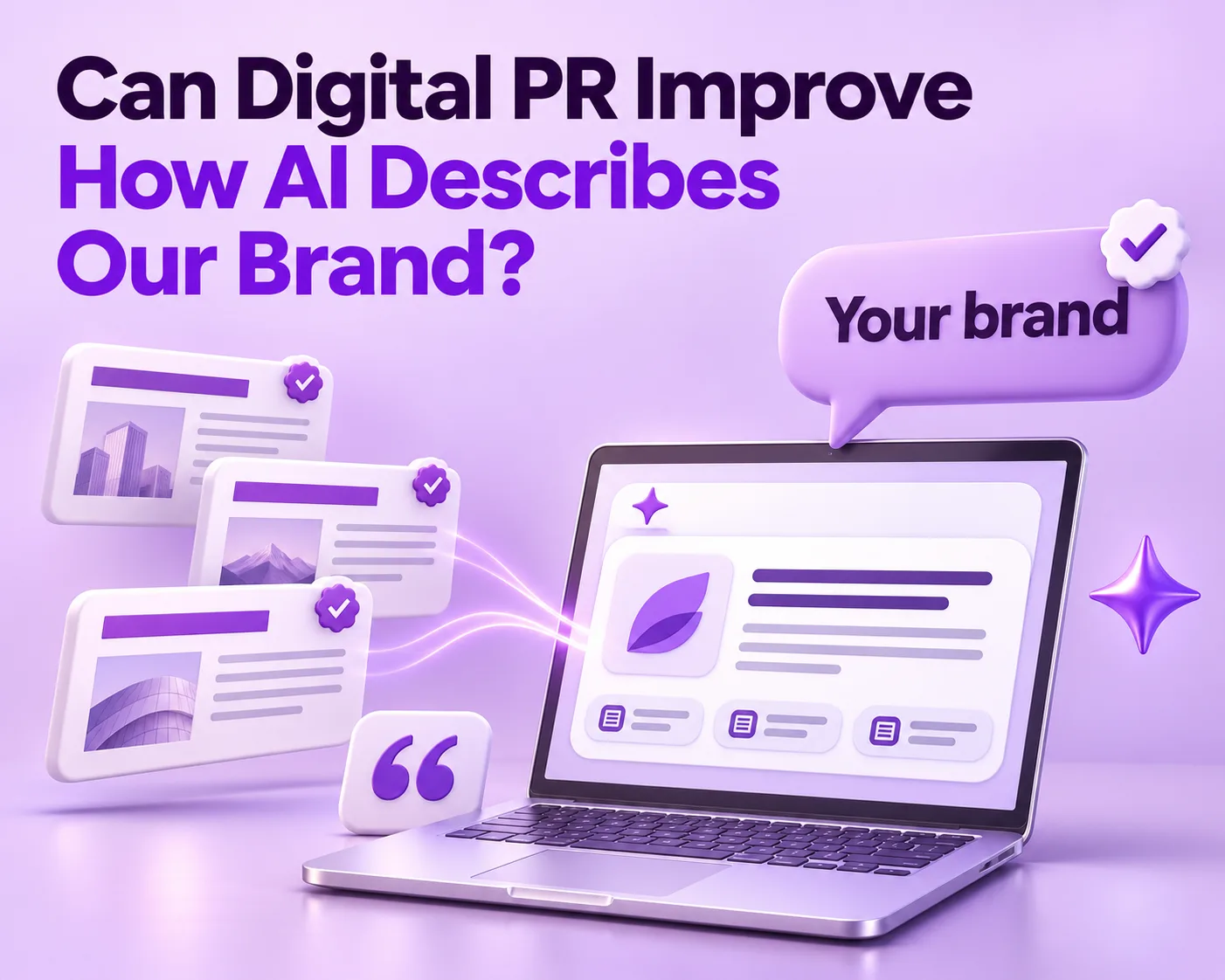
AI describes your brand using what other websites say about you, not just your own site. So if those sites are outdated or disagree with each other, AI can get your brand wrong. The sources AI trusts most are high-authority outlets, and that’s where digital PR earns you coverage with accurate, up-to-date facts. Over time, those new sources lead AI to describe your brand as it really is.
We're a digital PR agency that runs AI citation campaigns, so this guide sticks to what changes AI answers in practice. It covers where AI gets its picture of you, the five ways digital PR changes it, what PR can't fix, and how to start.
How Digital PR Changes What AI Says About Your Brand
Digital PR influences AI answers by changing the material AI reads about you. It does that in five ways.
1. It Gives AI Independent Proof to Repeat
AI treats what you say about yourself as one-sided and looks for confirmation elsewhere. About 84% of AI citations come from earned and third-party sources, and just 0.3% from paid content. So your homepage has less say in what AI tells buyers than what journalists and trusted industry voices write about you.
That third-party coverage is exactly what digital PR earns. Check which pages AI cites for the questions you want to show up in, then use PR to get your brand into those sources. For a SaaS brand, we ran a study ranking the top 40 US cities for remote workers and earned coverage from Yahoo News, MSN, the Miami Herald, and others. The brand then started appearing in ChatGPT and Google AI Mode answers to remote-work questions.
2. It Sets the Words AI Puts Next to Your Name
AI learns what your brand is from the words that appear around your name on other sites: your category, the problems you solve, who you serve. In a study of 75,000 brands, brands mentioned on more websites showed up in Google’s AI Overviews far more often, and mentions mattered about three times as much as backlinks. In plain terms, the more sites talk about you, the more AI talks about you, even when those sites don’t link to you.
So if the web mentions you in only one context, AI describes you only that way. Digital PR lets you choose the context: data studies, expert comments, and roundups on the topics you want to own put your name next to them on many sites. Our guide to digital PR for GEO covers how to pick those topics.
3. It Corrects Wrong Facts
AI fills gaps with guesses. In a test of 165 London businesses, half of smaller firms got at least one false fact from AI, compared with 32% of large companies, most often on company size, founding year, contact details, and services. That means a buyer asking AI about you could get the wrong phone number or a service you don't offer. Rebrands make it worse, because old articles keep describing your old name or services you dropped.
Every new placement restates your current facts, ideally from one shared boilerplate. Fresh coverage also gets more room: on October 15, 2026, Google expanded news carousels inside AI Mode and AI Overviews. The more recent, consistent pages exist about you, the less AI leans on old ones.
4. It Widens Your Footprint Across AI Tools
Each AI tool mostly reads its own set of sources. In one large study, only 212 websites were cited by all four of ChatGPT, Claude, Gemini and Perplexity. So looking good in ChatGPT tells you little about what Gemini says to the same buyer.
Digital PR fixes that by spreading across national, trade and regional outlets, and across countries. For an ecommerce brand, a data study ranking royals by style influence earned coverage in the US, UK, France, Italy and Taiwan, including Cosmopolitan, Parade, AOL and TF1 Info. Each market got a trusted local source describing the brand the same way. This increased the chances of appearing in all possible AI answers.
5. It Gives AI Reasons to Praise You
Most AI mentions are flat. More than half of the brand mentions in ChatGPT are neutral: they name the brand but say nothing good or bad about it. That puts you on the list without giving buyers a reason to choose specifically you.
Digital PR earns the third-party praise AI can repeat: expert rankings, awards, "best of" roundups, and coverage of your results. When several trusted sites call you strong at something, AI says so too.
What Digital PR Can't Fix On Its Own
Digital PR will do its job, but AI doesn't only read press coverage. It also reads your own site, forums, and reviews, and it never answers exactly the same way twice. Here's what to handle alongside PR so the coverage pays off.
Your own pages have to agree. AI still checks what you say about yourself, and in one audit, claims backed only by a brand's own pages were confirmed 75.2% of the time. If your site, LinkedIn, and directory listings tell a different story from your coverage, AI gets mixed signals, so keep one clear set of facts everywhere.
Customers talk where AI listens. If people complain on Reddit, review sites, or forums, AI will repeat it, and Gemini pulls heavily from Reddit. PR can add context and show what you've fixed, but it can't erase a complaint that's true.
No one can guarantee an answer. AI tools rarely give the same answer twice, and the same question can return different citations. If someone promises you a fixed spot inside ChatGPT, be wary: PR raises your odds across many answers; it doesn't lock one in.
Some answers update slowly. Tools that search the web live can pick up new coverage within weeks. Answers drawn from a model's training data change only when the model is updated, which can take months.
How to Start Improving How AI Describes Your Brand
Start by finding out what AI says about you today. These three steps show you where digital PR will pay off fastest, before you spend anything.
- Ask AI your buyers' questions. Run 10 to 20 of them in ChatGPT, Gemini, Claude, Perplexity, and Google AI Mode, such as *"best [category] for [use case]"* or *"what is [your brand]"*. Save the wording and the cited sources. You'll see which errors and gaps are costing you buyers, and you'll have a baseline to measure results against.
- Write a one-page fact sheet. Your category, what you do, who you serve, founding year, locations, pricing model, and two or three proof points. Make your site and profiles match it, so every journalist and every AI tool gets the same version of you.
- List the sources AI cites for competitors. These are the outlets AI already trusts in your category, so coverage there changes answers fastest.
Want this done for you? At Pressora, we specialize in AI citation campaigns that start with a citation gap analysis of your top 50 buyer questions. You'll see what each AI tool says about you, which sources drive it, and which placements would change it. Book a free strategy call to get your results and a custom plan to get you where you aim to be.
Frequently Asked Questions
How long does it take for AI to describe my brand differently?
AI tools that search the web live, like Perplexity and Google AI Mode, can reflect new coverage within weeks. Answers drawn from training data change only when the model is updated, so plan for a campaign of at least three to six months.
How do I measure whether digital PR is changing AI answers?
Run the same set of buyer questions every month and record the wording, tone, and cited sources, alongside the usual digital PR campaign metrics. Run each question several times, because the same question can return different citations, so one answer proves little.
Can I pay to change what ChatGPT says about my brand?
No. You can buy ads next to ChatGPT's answers, but OpenAI says ads don't influence the answers themselves. Paid and advertorial content also makes up a tiny share of what AI cites.
Is this the same as SEO or GEO?
They overlap. SEO and GEO (generative engine optimization, making content easy for AI to cite) focus mostly on your own pages. Digital PR works on the third-party pages that make up most of what AI cites, and the same digital PR coverage supports your SEO through links.
Does this work for smaller brands?
Yes, and the need is often bigger. Smaller firms are more likely to be confused with other brands or have facts invented about them, so each accurate placement carries more weight.

