




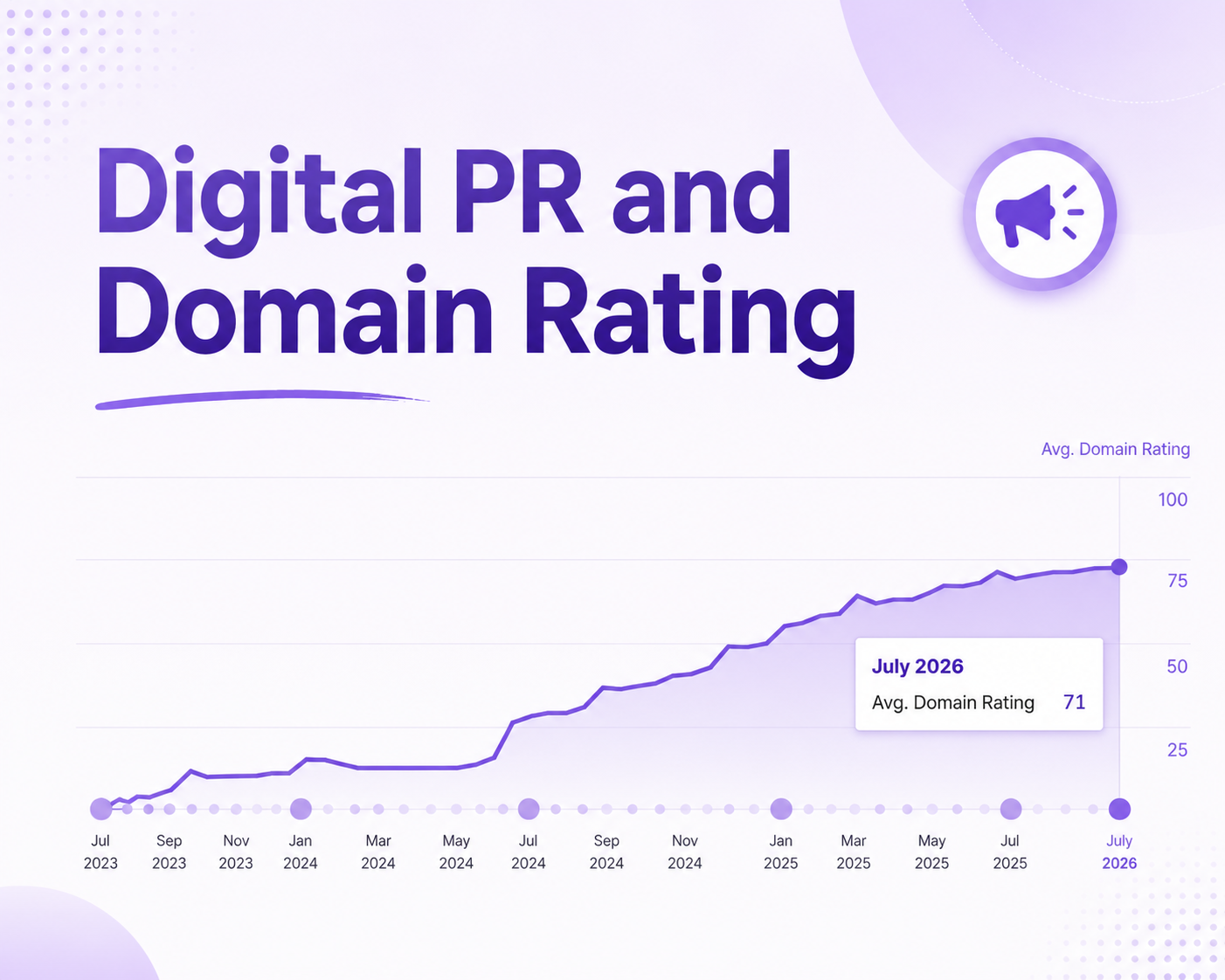
A digital PR campaign raises your Domain Rating (DR) by earning dofollow backlinks from a wide range of high-authority, unique websites. The more relevant and authoritative those sites are, and the more of them you earn, the higher your DR climbs. It's that simple, and it's the whole mechanism - everything else is detail.
Here's what that detail looks like, backed by real numbers, plus a live example of a site that went from DR 15 to DR 71.
Why DR Moves When You Run Digital PR
DR is a simple calculation based on your backlink profile, so only a few things move it:
- Unique referring domains matter more than link count. Ten links from ten different sites beat fifty links from one site. This is the whole reason digital PR outperforms link building as a DR strategy - it's built to generate coverage across many separate publications, not repeat placements on one.
- The linking site's own DR is what gets passed on. A link from a DR 80 news site does more for you than ten links from DR 20 blogs.
- Dofollow links count. Nofollow and syndicated links barely do. If your coverage is mostly syndicated wire pickups, don't expect much DR movement from it.
- DR is logarithmic. Going from DR 20 to 25 takes far less link equity than going from DR 65 to 70. The higher you already are, the more it costs to move the needle.
If you want the mechanics behind how those links get built, we've broken that down separately in how digital PR builds backlinks.
How Much DR Increase You Can Expect
Here's what the data shows across real digital PR programs:
- Average DR growth: around 3 points per year for a site running a consistent digital PR program.
- Starting point changes everything:
- Sites starting under DR 20 average +5.8 points/year
- Sites in the DR 20-60 range average +3.4 points/year
- Sites already at DR 60+ average +0.4 points/year - growth slows hard at the top
- Campaign frequency matters roughly linearly. Programs running 4+ campaigns a year see meaningfully faster growth than one-off campaigns; expect something in the range of 1 DR point for every 2 well-placed campaigns.
- Context for what "good coverage" looks like: the average DR of a single digital PR placement sits around 61 - so if an agency is pitching you sites well below that, your DR growth will lag the benchmarks above.
So, if you're already at DR 65, don't expect the same jump a DR 15 site will see. Set your targets by your starting band, not a flat number.
A Real Example: DR 15 to DR 71
Let me give you an example from a digital PR campaign by our digital PR agency.
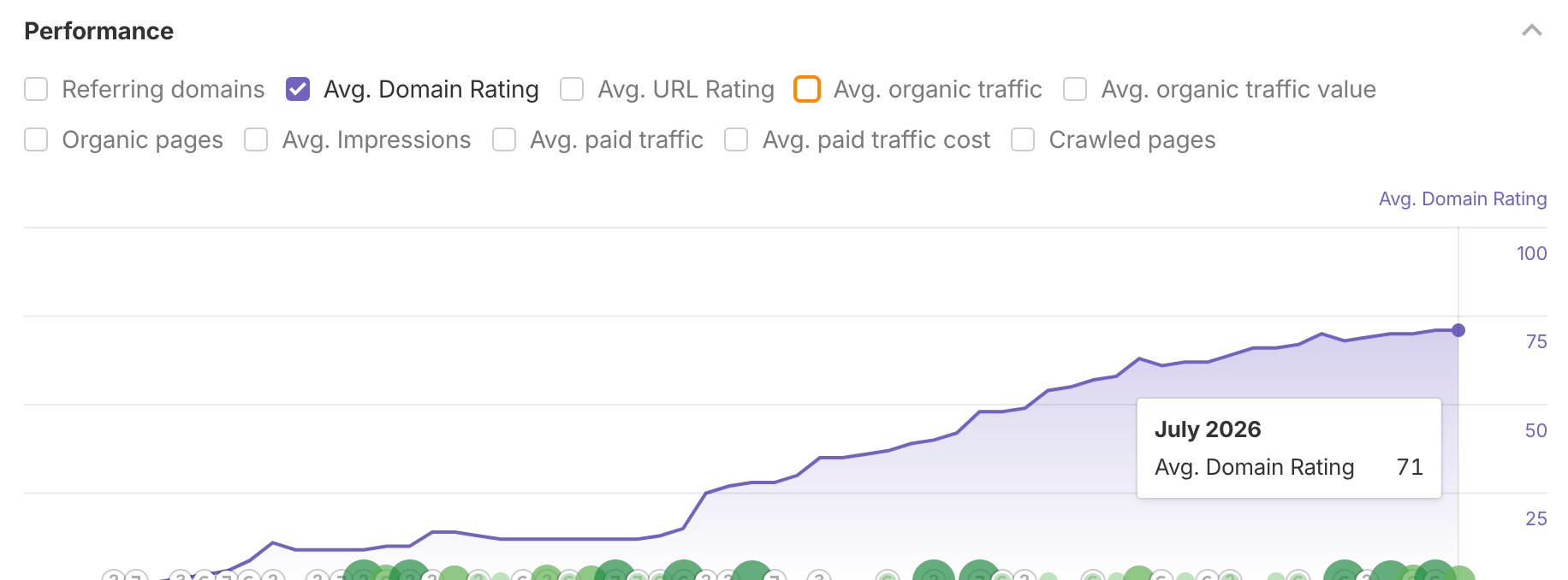
A digital business card platform we worked with started at DR 15. Through a sustained digital PR program, we took it to DR 71!
The approach mirrors what we ran for a SaaS client in a similar position: instead of chasing generic guest posts, we built an original data study - in that case, a ranked list of the best U.S. cities for remote work, scored across nine real factors like internet speed, salary, and cost of living.
That kind of angle gives journalists something worth writing about on its own merits, not something that reads like a plug.
The results from that approach:
- 36 backlinks from Yahoo News (DR 94), MSN (DR 92), Miami Herald, Men's Journal
- 20+ other regional and national publications, with dofollow links averaging DR 77
That's the pattern behind a DR 15 → 71 trajectory - not one viral hit, but a steady stack of unique, high-authority referring domains over time.
You can read more on the strategy we used in our case study on SaaS digital PR.
How Long It Takes For Digital PR Help DR?
DR doesn't move the week your content goes live. A realistic timeline:
- Weeks 1-4: Coverage gets published, and links go live.
- 1-2 months: Search engines and Ahrefs crawl and index the new links.
- 2-4 months: DR starts to reflect the new referring domains.
- 6-12 months: Compounding effect kicks in - each campaign builds on the last, so later campaigns tend to move DR faster than the first one did.
Keyword rankings often improve before DR visibly updates, since DR is a lagging, third-party metric rather than something Google uses directly.
What Doesn't Move DR?
Quick, direct answers to the questions that come up alongside this one:
Is DR the same as Google ranking?
No. DR is an Ahrefs metric, not a Google ranking factor. It correlates with rankings but isn't used directly in the algorithm.
Does one big placement move DR by itself?
Rarely. A single DR 90 link helps, but DR is a cumulative measure - it responds to the size and diversity of your whole referring-domain profile, not one story.
Do nofollow links help?
Marginally. Budget for dofollow coverage if DR growth is the goal.
Is DR the same as Domain Authority?
No - DR is Ahrefs' metric, DA is Moz's. Similar concept, different scale, different inputs.
Tracking DR Properly During a Campaign
DR shouldn't be your only KPI, but it's worth watching alongside referring domains, organic traffic, and keyword movement. We cover the full framework in how to measure your digital PR campaign, and if you're building out your own tracking stack, our breakdown of digital PR tools and software covers what's worth paying for versus what isn't.
Beyond DR: The Trust Signal Underneath It
DR is a proxy. What it's measuring is whether trusted publishers vouch for you - which is the same signal behind E-E-A-T and, increasingly, whether AI engines mention your brand at all.
If you're thinking about digital PR for ranking in AI search and GEO, the same high-authority placements that build DR are what build citation consistency there too - it's the same work serving two goals at once.
If you're not sure where your DR sits relative to where it should be for your industry, or what a realistic 12-month trajectory looks like for your site, that's exactly the kind of thing we map out before starting a digital PR program. Just jump into the free strategy call with us, and let’s chat.

