




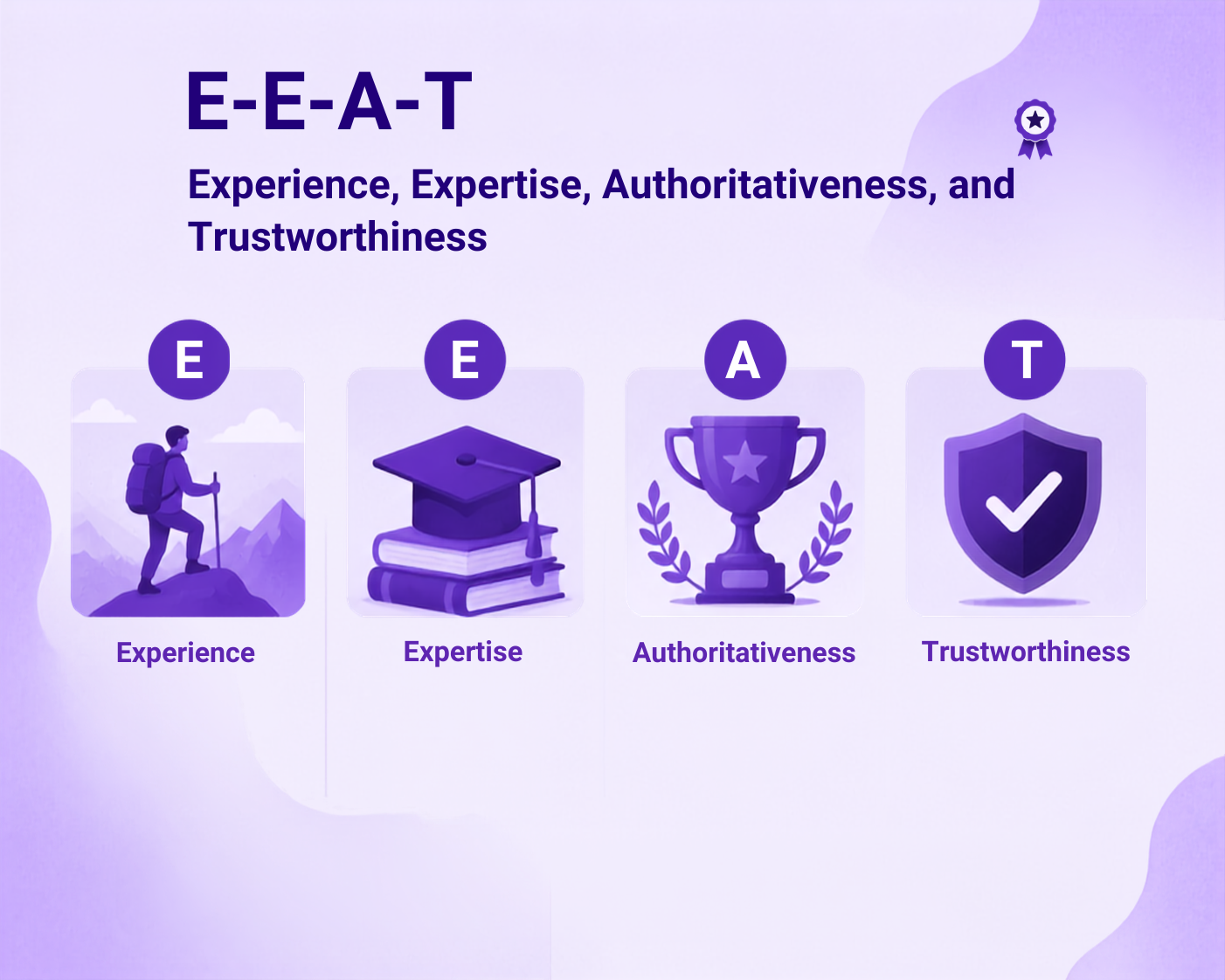
E-E-A-T isn't something you can write your way into. Google and AI search engines decide whether to trust a brand the same way people do: by checking what other, credible sources say about it.
Digital PR is built specifically to organically create that proof with real journalists at real publications, who choose to cover your brand because the data, the story, or the expert behind it is worth covering.
That's the entire connection in one sentence. Now, let me explain exactly how it works, pillar by pillar, and what to do about it, based on our digital PR agency’s expertise.
What Does E-E-A-T Mean?
E-E-A-T stands for Experience, Expertise, Authoritativeness, and Trustworthiness. It's the framework Google's quality raters use to judge whether content and the brand behind it can be relied on. Now it shapes how AI systems like ChatGPT, Gemini, and Perplexity decide which brands are worth citing too.
Disclaimer: the four letters aren't equal in weight. Trust is behind the other three. Experience without trust reads as an anecdote. Expertise without trust reads as opinion. Authority without trust is just a pile of links nobody asked for. None of the other pillars count for much until trust is established, and trust is, almost by definition, something only a third party can hand you. You can't self-certify it.
That's the entire reason digital PR exists as a separate channel, distinct from content marketing or social media.
Why Digital PR Builds E-E-A-T?
Your own website can claim anything. "Industry-leading." "Trusted by thousands." "20 years of experience."
Any company you try to find has these trust signals all over its pages. But none of it functions as an E-E-A-T signal on its own, because Google and AI models have learned that brands aren't reliable narrators of their own credibility.
What they trust instead is independent confirmation - a journalist at a publication with no relationship to you deciding your data, your expert, or your story is worth covering. That's what digital PR is at its core: earning coverage, rather than buying it or publishing it yourself.
This is also where digital PR splits from traditional PR. Traditional PR was built for name recognition, share of voice, "did people see us." In short, visibility.
Digital PR was built for something Google and AI models can read: backlinks, referring domains, branded search growth, all traceable back to a specific placement.
For E-E-A-T purposes, the difference matters because it's exactly those trackable signals that search engines and AI models are reading.
The E-E-A-T Pillar-to-Tactic Map
Let me map what separate digital PR tactics support each of the four letters:
Experience
Experience signals come from evidence, such as a named case study, a founder interview, or a product reviewed by a real outlet. These tell Google that real people interacted with your brand. Simply putting "founded in 2015" and creating some fake narratives on your About page doesn't really show experience.
Expertise
Expertise has to attach to a person. The fastest way to demonstrate it through digital PR is to get a specific team member quoted, bylined, or interviewed on a topic they're genuinely qualified to speak on, and to stay disciplined about which topics that is.
Or, you can have original ideas supported by your team’s original research. For example, for one of our SaaS clients, we created an original analysis ranking the best U.S. cities for remote workers across various factors. We showed expertise in our in-depth and useful analysis.
That single campaign secured 36 backlinks across outlets like Yahoo News, MSN, Miami Herald, and 20+ regional publications, and it did more for the brand's standing as a remote-work expertise than a year of blog content would have. Read more about results in our SaaS digital PR case.
Authoritativeness
This is also where the difference between digital PR and link building matters most, because earned coverage from a publication your audience reads carries more authority than a placement on a high-DR site nobody in your industry trusts.
Our ecommerce digital PR case study is a clean example of relevance playing the biggest role. We built an original study that scored royals worldwide on style influence and pitched it specifically to fashion and lifestyle media rather than general news. In a few weeks, we got 26 backlinks averaging DR 88, with placements in Cosmopolitan, Marie Claire, Parade, and PureWow, plus international pickup in France, Italy, and Taiwan.
Every one of those publications falls directly within the brand's category, which tells Google and LLMs that this is a recognized name in fashion.
Trustworthiness
Trust is built on claims that can be checked. The cleanest way digital PR does this is through original research with a transparent, sourced methodology.
In our law firm's digital PR case study, we targeted one of the most competitive terms in legal SEO ("criminal defense lawyer in Las Vegas") for a brand with almost no existing media presence. That was ambitious, but we had a plan.
We pulled FBI crime data for major U.S. cities and built a clean, ranked breakdown of crime rates per 100,000 residents. Because the underlying source was FBI data, journalists could run with it without verifying anything themselves.
That earned 35 backlinks, including placements on Yahoo News, MSN, and Men's Journal. Legal content falls into a category where Google and AI models apply extra scrutiny to accuracy, and a verifiable government data source is about as strong a trust signal as digital PR can provide.
The Digital PR Tactics That Build These Signals
Beyond the pillar-by-pillar breakdown, here are the practical digital PR tactics we run most often, and why each one earns the signal it earns.
Tier-1 and Hyper-Relevant Niche Placements
A mention in a major national outlet is great, but a string of placements in publications your exact audience reads builds topical authority faster than one big hit. Both have a place. The mistake is chasing only domain rating and ignoring whether the publication covers your space.
Reclaiming Unlinked Brand Mentions
If a site has already written about your brand without linking to you, that's a warmer ask than cold outreach - you're simply requesting a citation update. It won't build links at scale on its own, but it's close to free authority, and Google does still register a brand mention even without a hyperlink attached. So, indirectly, your digital PR helps your SEO.
Original Data and Research
This is the highest-leverage tactic on this list, and it's the one our team runs the most. The reason it works is that journalists need fresh numbers, and most available data has already been cited everywhere. If you bring something nobody else has, you become the source.
What we've found as the most effective, based on testing dozens of campaigns:
- A genuinely surprising finding. Memphis topping a crime-rate ranking, or Frisco, Texas beating San Francisco for remote work, gets covered.
- A credible underlying source. FBI data, internal customer data, or a properly sized survey - something a journalist doesn't have to fact-check from scratch.
- A documented methodology. Sample size, date, and scoring criteria, stated plainly. This is what makes a study citable months later, not just in the first week.
- A permanent home for the data. A dedicated landing page the research lives on, so it keeps earning citations long after the initial press cycle ends.
Expert Commentary, Bylines, and Podcasts
Getting a named expert quoted in the trade press, writing a bylined article, or appearing on a relevant podcast all send the same signal: a third party has decided this person's opinion is worth platforming.
The only rule that matters here is staying in lane - commentary outside your real area of expertise dilutes the credibility you're trying to build, rather than adding to it.
Newsjacking and Reactive PR
Attaching expert commentary to a story that's already trending works because journalists are actively looking for new angles while a topic is hot. It's faster than a planned campaign and, done well, gets you into coverage you'd never get cold.
Why Does Digital PR & E-E-A-T Matter for AI Search?
AI platforms don't crawl your website and decide you're credible. They synthesize answers and cite sources they've already assessed as trustworthy, and that assessment is built almost entirely from earned media signals.
Research from Muck Rack found that the large majority of brand citations inside ChatGPT responses trace back to press coverage and editorial mentions. We've seen this directly: one ecommerce campaign took a client's target page from zero ChatGPT citations to 31, purely through consistent placements in relevant publications. So, there is a direct connection between digital PR & GEO outcomes.
The underlying mechanic is entity recognition. AI models build associations between your brand and a topic by observing how often the two appear together across sources they already trust. One mention barely registers. Consistent, relevant coverage compounds, which is the same logic that's always applied to SEO authority, just measured differently now.
E-E-A-T For Regulated, High-Scrutiny Industries
Google and AI models apply stricter standards to brands operating in sectors where misinformation can cause real harm: legal, financial, medical, and gambling content are all held to a higher bar.
If you're in one of these spaces, a thin E-E-A-T profile is often the reason you're invisible in search.
iGaming and online casino brands face this in an especially acute form: strict regulation on where content can run, heavy competition, and a long history of spammy operators that's made mainstream publishers cautious about linking to anything gambling-related at all.
Because of that, data-led, white-hat strategies are the only way for digital PR in iGaming and casino brands and every other regulated vertical.
A Quick E-E-A-T Self-Audit for Digital PR
Run through these four questions. If you can't answer "yes" to most of them, that's your starting point:
- Experience: Has a third party documented your real-world results in the last 12 months - a case study, a review, an interview?
- Expertise: Can you name the specific person at your company who'd get quoted on your core topic, and has a journalist quoted them recently?
- Authoritativeness: Are the sites linking to you ones your actual customers read, not just ones with a high domain rating?
- Trustworthiness: If a journalist or an AI model fact-checked your last big claim, is there a clear, citable source behind it?
Key Takeaways
- E-E-A-T is built almost entirely off-site, based on evidence other people provide.
- Trust is the foundation on which the other three pillars sit, not an equal fourth pillar.
- Digital PR is the discipline purpose-built to generate that proof: earned coverage, original data, and credible third-party validation.
- The same signals that build E-E-A-T for Google now determine whether AI platforms cite your brand at all.
- The bar is highest in regulated industries, which is exactly where a strong digital PR strategy matters most.
If you want help applying any of this to your own brand, get in touch with us and let’s have a free chat on what could be done for your case.
FAQ
Do unlinked brand mentions help SEO?
Yes, to a degree. Google can recognize a brand name even in the absence of a hyperlink, when it appears alongside relevant context, and this contributes to entity recognition for AI models. A linked mention is still stronger (it passes authority and lets users navigate directly to you) so reclaiming unlinked coverage into a link is always worth the outreach.
Is digital PR the same as link building?
No. Link building is the act of placing a link — you choose the site, you request it, you control the placement. Digital PR earns the link as a byproduct of a journalist deciding your story or data was worth covering. The mechanism is different, and so is how much weight Google and AI models give the result. See Digital PR vs Link Building for the full comparison.
How long before digital PR affects E-E-A-T and rankings?
Coverage and backlinks can land within weeks of a campaign launching. Measurable ranking movement typically takes 3–6 months, since authority compounds as links get indexed and your off-site footprint builds consistency over time.
Does this matter more for YMYL sites - health, finance, legal?
Yes. Google applies stricter quality thresholds to content that can affect someone's health, finances, or legal standing, which means weak E-E-A-T signals hurt more in these categories and strong ones (particularly verifiable, sourced data) matter more.
How do you measure ROI on digital PR?
Track it on three levels: direct SEO metrics (backlinks earned, domain rating growth, target keyword movement), traffic metrics (referral traffic from placements), and brand metrics (growth in branded search volume and share of voice). For AI visibility specifically, run a consistent set of prompts across ChatGPT, Perplexity, and Google AI Overviews monthly and track whether and how your brand shows up.

