




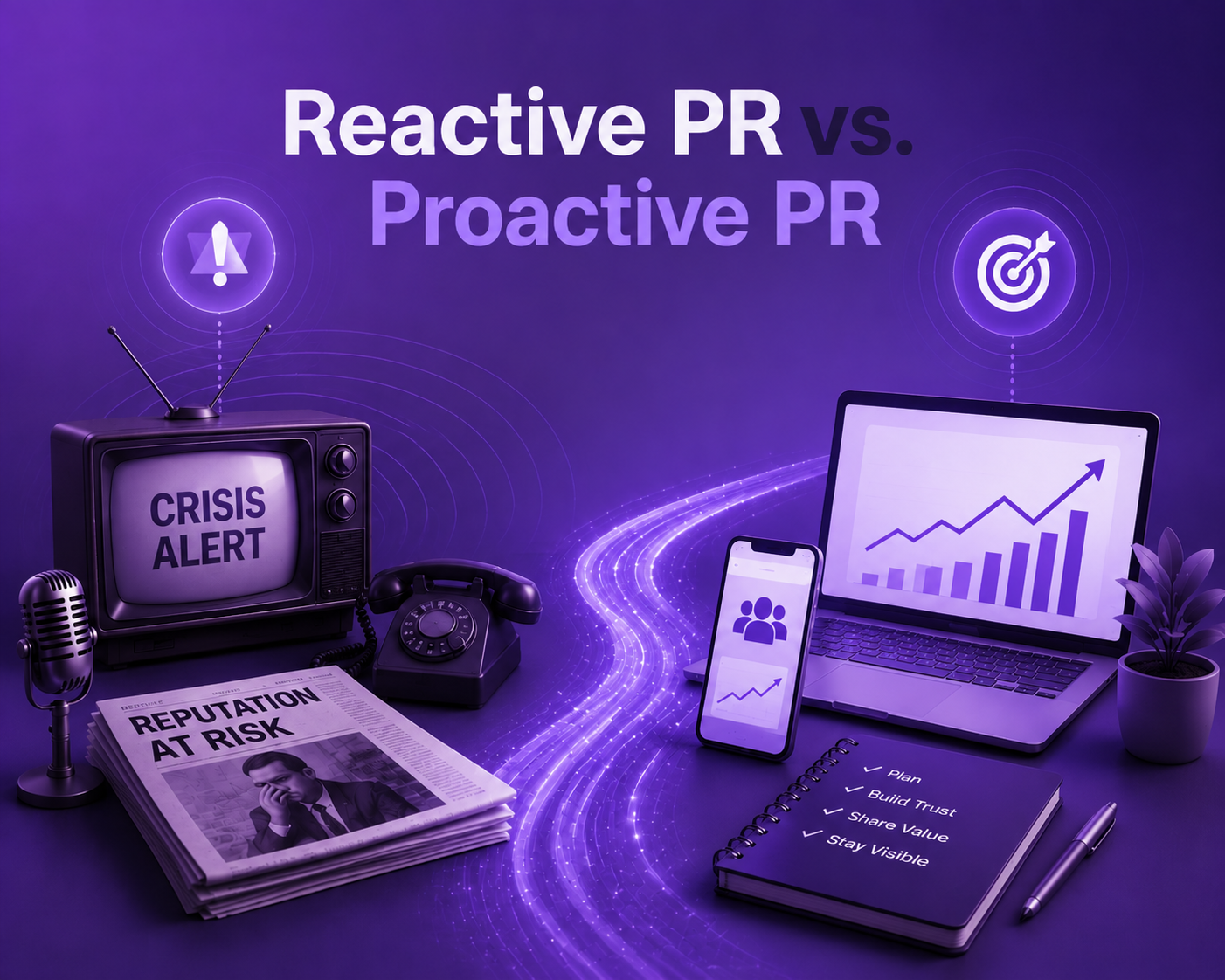
In my experience, every PR strategy comes down to one core tradeoff: do you spend your time and budget planning stories in advance, or staying ready to jump on what's already happening?
The answer is somewhere in the middle - prioritize proactive PR, but don't skip reactive PR.
Below, I'll cover how to tell which one deserves more of your time right now, and how to run both without one undercutting the other.
The Short Answer: Reactive PR vs. Proactive PR
Proactive PR is planned - you control the timing, the message, and the story.
Reactive PR is responsive - you're reacting to news, trends, or a crisis that's already unfolding.
Proactive builds your reputation over time. Reactive protects it when something unexpected happens, or capitalizes on a moment while it's still relevant.
You need both, but they're not equally weighted by default:
If your brand has no proactive foundation, reactive PR won't land - journalists and audiences don't have context for who you are. If you only do proactive PR, you'll get blindsided the first time something goes wrong, or you'll watch a relevant news cycle pass you by.
This is the same logic that separates digital PR from traditional PR - the channels have changed, but the need to plan and stay agile hasn't.
What Is Proactive PR?
Proactive PR is any PR effort you initiate before anything forces your hand. You pick the timing, the angle, and the outlet.
In practice, it looks like this:
- Press releases tied to product launches, funding announcements, or company milestones
- Thought leadership articles and expert bylines
- Original research or data studies designed to earn coverage
- Award and ranking submissions
- Planned events, partnerships, and sponsorships
What it's good for: Proactive PR is how you build the reputation that everything else rests on. It's a slow build - you're establishing relationships with journalists, defining your brand's voice, and creating a body of coverage that positions you as a credible source. This is also where digital PR earns backlinks that compound your SEO over time.
Where it falls short: It can't predict or respond to what happens outside your plan, and it takes time - you won't see meaningful results in week one. If your brand is new to the press, expect the first few months to function as an introduction.
A good example of proactive PR compounding into real business results is our e-commerce digital PR case study, where a sustained, planned outreach strategy built the kind of authoritative link profile that moves organic rankings over the long term.
What Is Reactive PR?
Reactive PR is your response to something that's already happening - a trend, a piece of breaking news, a journalist request, or a crisis.
In practice, it looks like this:
- Newsjacking a trending topic with a fast, relevant take
- Responding to journalist requests for expert commentary
- Issuing a statement or holding the line during a crisis
- Jumping into a viral moment with brand commentary
What it's good for: Speed and relevance. Reactive PR lets you tap into media attention that's already at its peak, which is often when it's easiest to earn coverage and backlinks, because journalists are actively looking for an angle. It's also your only real tool during a crisis, when staying silent or slow is its own kind of statement.
Where it falls short: You don't control the full narrative - a journalist can use your quote however it fits their story. And if your reactive moments aren't tied to a consistent brand voice, they can make you look scattered rather than sharp. ‘
This is also the area where industries with higher reputational stakes, igaming being a clear example, need a genuinely fast, pre-approved response process, because the cost of a slow or off-brand reaction is higher than in most sectors.
Reactive PR vs. Proactive PR: Side-by-Side Comparison
Which Should You Prioritize? Use This Decision Framework
These recommendations are based on our experience working with brands of all types and sizes on digital PR campaigns.
For a relatively unknown and/or new brand, be proactive about public relations. Reactive public relations can only be effective when reporters know enough about the brand and feel good about their commentary. Without proactive groundwork, reactive pitches will not work.
For an established brand with established media contacts, you should lean more on reactive public relations. You have earned the credibility; now you are just putting it to use in real time.
For industries that pose higher risks or are more regulated (financial services, law, healthcare, gambling), it is necessary to spend more time preparing for reactive public relations than on using it, even if not often. Holding statements and the ability to get something approved in an hour or less is critical regardless of how often you intend to newsjack.
For a resource-constrained team (a small team or a single in-house person): Proactive PR is easier to schedule around your capacity. Reactive PR requires monitoring infrastructure and someone available to move fast, which is harder to guarantee with limited headcount. Build your monitoring setup before you commit to being reactive at all.
The 70-80/20-30 ratio of proactive/reactive PR you will see everywhere is a good starting point for an established moderate risk brand. Use it as a basic guideline that you tweak.
How to Combine Both Reactive and Proactive PR into One Strategy
The two aren't competing budgets - they reinforce each other when they're run together.
Proactive work makes your reactive PR better. A brand with an established tone of voice, clear values, and existing media relationships can respond to a crisis or a trending moment far faster and with far less risk of misfiring. Without that foundation, reactive comments tend to look rushed or inconsistent - journalists and audiences pick up on it.
Reactive moments feed your proactive pipeline. A strong crisis response or a well-executed newsjack often becomes its own proactive story later - a case study, a thought leadership piece, a "how we handled it" narrative. The two feed each other in both directions.
One brand voice runs through both. Your proactive messaging and your reactive holding statements should sound like they came from the same brand. Consistency across everything you publish, planned or not, is what search engines and journalists both reward.
Based on our experience, it also matters for E-E-A-T signals - a brand that shows up consistently, in both planned and responsive coverage, builds trust signals that a string of disconnected hits never will.
Practically, this means:
- One editorial calendar for proactive content, reviewed monthly
- One crisis plan with pre-approved holding statements, reviewed quarterly
- Shared media monitoring so reactive opportunities get surfaced to the same team running proactive outreach
- Consistent anchor text and linking approach across both - see our guide on anchor text best practices in digital PR if you're running both alongside a link-building program
Tools You Need for Each
For proactive PR: content planning tools, a media database for journalist outreach, and a CMS or press page for hosting releases. Speed matters less here than research quality and targeting.
For reactive PR: media monitoring tools (Google Alerts, Prowly, Mention, Meltwater), social listening tools to catch sentiment shifts early, and a pre-built approval chain so a statement doesn't sit waiting for sign-off while the news cycle moves on.
For a fuller breakdown of what's worth using at each stage, see our roundup of digital PR tools and software.
Bottom Line: Which Should You Prioritize?
After discussing this question with my Digital PR agency's team of digital PR experts, this is the consensus we reached:
Prioritize proactive PR as your foundation, and build reactive capability alongside it from day one. The split shifts depending on your brand's maturity and industry risk.
Need help building a PR program that balances both? Get in touch with us for a free strategy call!
FAQ
Is it better to be proactive or reactive?
Proactive PR should be your primary strategy - it builds the credibility and media relationships that make reactive PR effective in the first place.
What are the 3 C's of PR?
The 3 C's are typically defined as Clarity, Consistency, and Credibility - the message has to be clear, delivered the same way across channels, and backed by a source people trust. Both proactive and reactive PR depend on all three; reactive PR in particular fails fast without consistency.
What are the 4 pillars of PR?
There are four pillars in public relations. These include media relations, content strategy, crisis management, and internal/stakeholder communications. Proactive PR is mainly in media relations and content strategy, while reactive PR is mainly in crisis management, and that is the very reason why a strategy formed by just one pillar is not complete.

