



Yes, and it matters more than it used to. Search engines and AI tools now answer most questions right there on the results page, which means your website often isn't the first place someone meets your brand anymore.
Whatever shows up instead has to come from somewhere those AI systems already trust, and that trust gets built off-site, through independent coverage you don't control. That's the job digital PR does.
So, let me explain why SEO and content marketing alone won’t cover the whole picture for you, and why you need digital PR in 2026 ad beyond.
What Has Changed with Zero-Click Search?
A zero-click search is exactly what it sounds like: someone gets their answer on the results page and never visits a site. Featured snippets, AI Overviews, "People Also Ask" boxes, and now full AI-generated summaries are all versions of this.
Pew Research looked at what happens when an AI Overview shows up on a Google search and found people click through to a regular result only about 8% of the time, versus 15% when there's no AI summary. Links inside the AI Overview itself barely get touched, around 1% of visits.
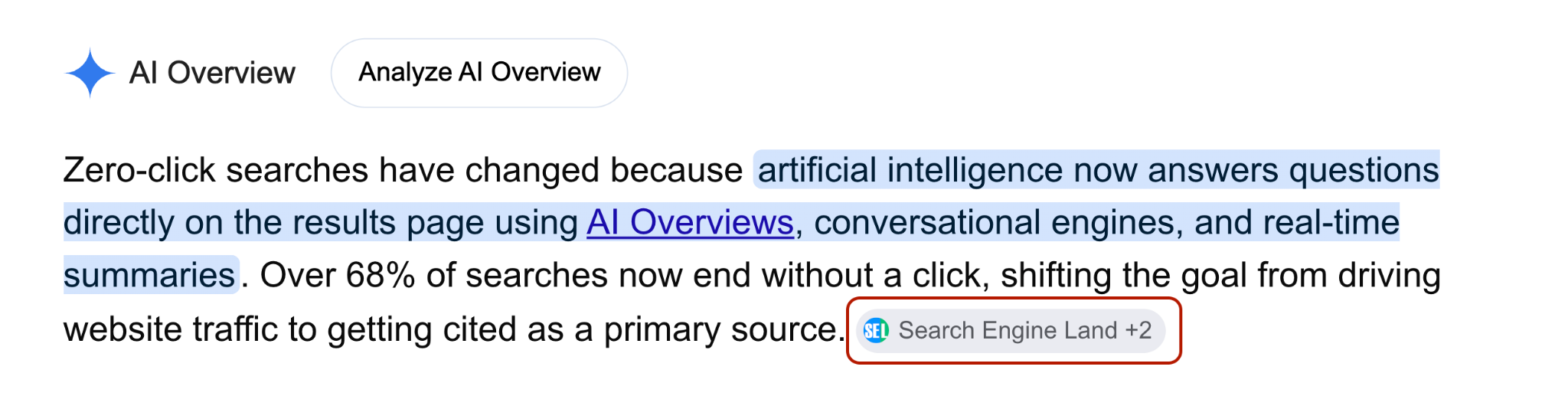
That's a real shift in how information reaches people, and it’s not necessarily something bad for your brand. This simply changes the way you should be optimizing and tracking your marketing efforts.
Traffic used to be the evidence your marketing was working. Now the evidence looks more like: did the AI name you, quote you, or recommend you, regardless of whether anyone clicked afterward.
Why Digital PR Specifically Helps AI Visibility?
Most advice on this topic sticks to schema markup, content structure, and snippet formatting. Useful stuff, but it only solves half the problem. It helps machines parse your own site more easily. It doesn't do anything to convince those machines your brand is worth citing in the first place. That second part is where digital PR does the work.
Entity Verification
AI systems and Google's Knowledge Graph don't just take a brand's word for who it is. They cross-reference against what's already been said elsewhere. A brand that's been written about by reputable, independent outlets reads as a real, established entity. A brand that only exists on its own website and social accounts doesn't carry that same weight, no matter how clean the site's SEO is.
It's the same logic behind E-E-A-T: earned coverage does something owned content structurally can't.
Citation Fuel
Generative AI tools build their answers by synthesizing across the open web, and they lean toward sources that are already widely linked to and referenced. Earned coverage in trusted publications feeds straight into that pool. Good placements don't just sit on a media page somewhere waiting to be found. They get picked up, referenced elsewhere, and pulled into the material AI models draw on when forming an answer about your brand or your industry. I go deeper on this mechanism in digital PR for GEO guide.
Third-Party Validation You Can't Fake with Schema Markup
Schema markup tells a machine how to read content you already control, which is useful, but it's still just you describing yourself. Digital PR gets other people, ideally credible, independent ones, to describe you instead. That's a different kind of signal, and it's the one AI systems tend to weigh more heavily when deciding whether a source is trustworthy.
What Does Digital PR for AI Visibility Look Like in Practice?
Digital PR for AI-era visibility isn't press releases sitting in an online newsroom. It's specific, repeatable tactics:
- Original research and proprietary data. Journalists and AI models both need something to cite. A dataset or survey nobody else has is the easiest thing to get picked up.
- Expert commentary and bylines. Contributing to trade press puts your name and your brand inside content that already has established authority.
- Wikipedia and Wikidata presence. Knowledge graphs lean on these heavily when verifying entities.
- Wire distribution with actual pickup. The value isn't the release going out, it's independent outlets running with it.
- Podcast and interview appearances. Transcripts are crawlable, quotable, and citable in a way a lot of other content isn't.
We put this into practice for a client in a heavily regulated, competitive space. Our law firm case study shows how targeted earned coverage built topical authority and third-party trust signals for a firm competing against much larger, better-known names, without relying on paid placement or volume alone.
Similar logic works for any other industry, even heavily regulated ones like iGaming digital PR, where trust and regulatory scrutiny make earned coverage especially valuable.
How to Measure Whether It's Working
Clicks alone won't tell you if this is working, because the whole point is that some of the value now happens without a click. Track these instead:
- Share of Answer. How often your brand shows up when AI tools answer questions in your category.
- AI Citation Frequency. How often your content or brand gets referenced inside AI-generated responses.
- Branded Search Volume. If people see your name in an AI answer and then search for it directly, that's a strong trust signal, even without an immediate click.
- Referring Domains and Coverage Quality. A mention in a publication AI models already trust does more work than ten mentions on low-authority sites.
For a full breakdown of how to build this into a reporting framework, see our guide on digital PR campaign measurement, or you look at the top digital PR tools to track your coverage and citation performance.
Digital PR vs. SEO vs. Content Marketing: How They Divide The Work in Zero-Click Search World
These three get blurred together constantly, and that confusion is part of why brands underinvest in PR specifically. Here's the division of labor:
None of these replace the others. SEO without something worth citing doesn't get picked up. Content without PR stays buried on your own site. PR without a solid site and content to point back to has nothing to convert visibility into. Earned, paid and owned media can all work together, to help you get found and appear in citations.
So, Is Digital PR More or Less Important Now?
More. Earned coverage was always about reputation and backlinks. Now it's also doing a second job: feeding the trust signals that AI systems use to decide who gets cited and who doesn't. That's more work being done by the same discipline.
That being said, if you’re starting from zero (and without a dedicated team) on this very important task, there will be information fatigue and you’re likely to fail fast. Contact us, let’s talk (for free), and our experts can brainstorm on possible digital PR solutions for you during the strategy call.
FAQ
Does Digital PR Help with AI Overviews Specifically?
Yes. AI Overviews and similar tools pull their answers from sources that already have independent authority signals. Earned coverage in reputable outlets with digital PR increases the chances of your brand or content getting included in that pool.
Do Backlinks Still Matter if AI Answers Don't Need Clicks?
Yes. Backlinks remain one of the clearest signals of credibility that both traditional search algorithms and AI models rely on. How digital PR builds backlinks explains the mechanics.
How Long Does It Take for PR Coverage to Show Up in AI Citations?
It varies, but it's not instant. Coverage needs to get indexed, linked to, and referenced elsewhere before it becomes part of what AI models draw from.
Consistent, ongoing coverage works better than a single placement, which is also why brand-building through PR is a compounding effort rather than a one-off campaign. Digital PR for brand building covers this in more detail, as does our guide on how digital PR cuts through a crowded news cycle for staying visible amid the noise.

