



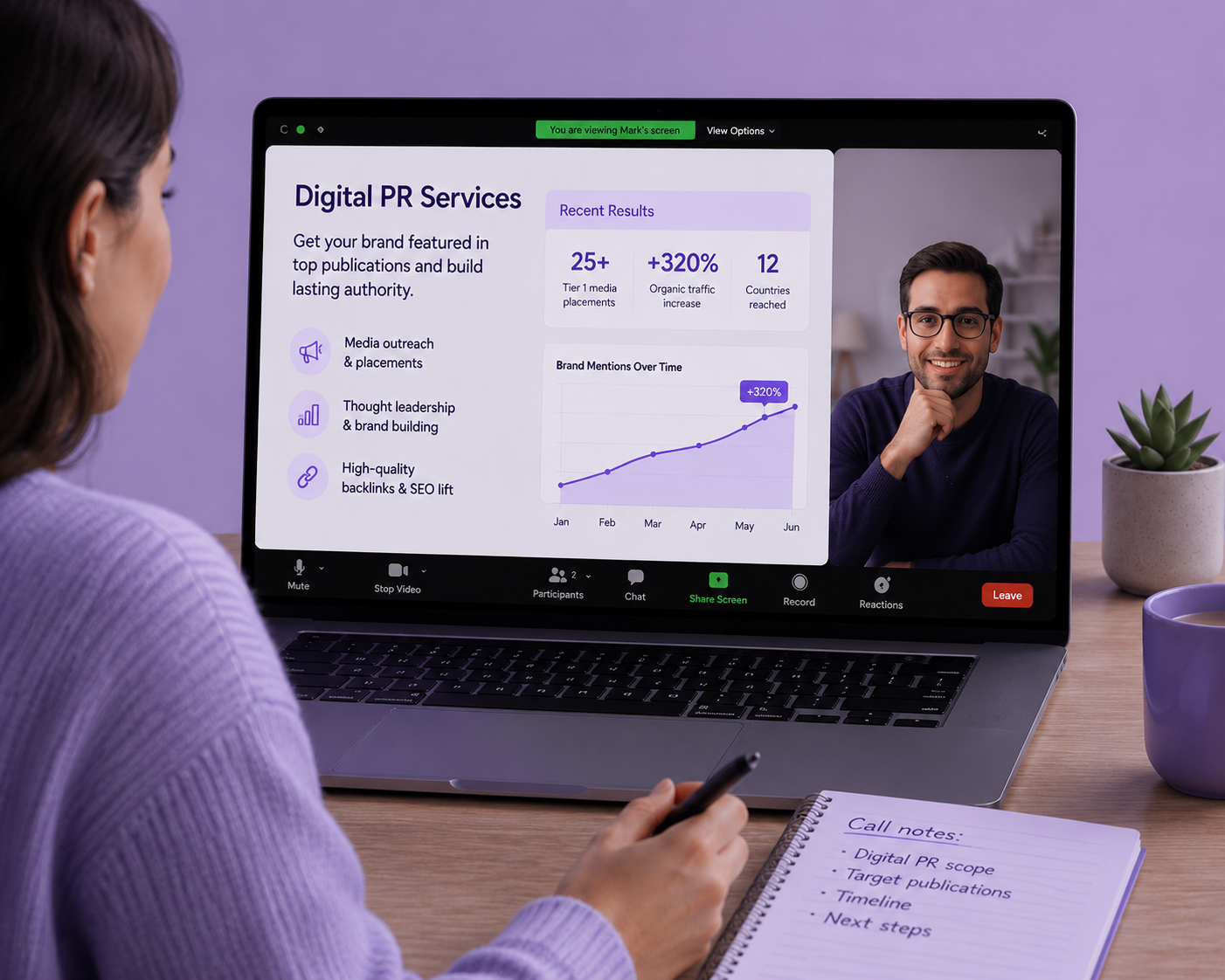
Top digital PR agencies offer earned media placements, data-driven content built specifically to attract journalists, SEO- and GEO-integrated link building, online reputation management, and social/influencer amplification - all measured against backlinks, AI citation frequency, and real organic traffic.
We've run digital PR campaigns for law firms, e-commerce brands, iGaming operators, and SaaS companies at our digital PR agency, so this isn't a theoretical breakdown. It's what we deliver, how we measure it, and what to watch for when you're vetting a partner.
The Core Services a Digital PR Agency Should Offer
If you strip away the jargon, a competent digital PR agency offers five things. Here's what each one looks like in practice.
1. Strategic Media Relations & Earned Coverage
This is the foundation: putting your brand, data, or expert commentary in front of journalists and getting them to write about it - because it's genuinely useful to their readers, not because they were asked to.
A few things worth knowing before you sign a contract:
- Links from press release wires are almost always nofollow. So if an agency pitches press release distribution as your main link-building tactic, the real value is the pickup and audience reach.
- Good media relations isn't about blasting the same pitch to 500 inboxes. It's about matching your story to the right journalist's beat, at the right time.
- Editorial coverage on a legal topic reads differently from coverage on an e-commerce product launch. In our law firm digital PR case study, the pitch angle had to lean on regulatory nuance and third-party legal commentary - a generic "we launched a new service" pitch wouldn't have landed with the outlets we targeted.
2. Data-Driven & Original Content Creation
Journalists cover stories. The best digital PR agencies build the story first (through original surveys, proprietary data analysis, and industry benchmarks) and then pitch it.
A single well-executed data study can generate dozens of placements over months, because journalists keep citing it long after the initial pitch cycle ends. It also becomes a reusable asset for your own content and sales enablement - one research project, multiple uses.
For an e-commerce brand, that might mean analyzing purchasing trend data across a category. For a SaaS company, it might mean surveying your own user base on an industry pain point. In our e-commerce digital PR case study, the data hook came directly from first-party sales and search behavior - information competitors simply didn't have access to, which is exactly why journalists picked it up.
3. SEO & GEO (Generative Engine Optimization)
SEO-integrated digital PR means every placement is chosen with search value in mind: the outlet's domain authority, topical relevance, and whether the link points to a page that needs the equity.
GEO-focused digital PR extends that logic to AI search - making sure your brand shows up in publications that large language models pull from and cite when generating answers. That's a genuinely different targeting exercise than traditional link-building, because the publications AI models cite most aren't always the same ones that rank highest in classic SEO terms.
We've tracked AI citation frequency as an explicit KPI on client campaigns for over a year now, and it's changed how we choose outlets - a mid-tier trade publication that gets cited consistently by AI tools can outperform a bigger, more "prestigious" outlet that AI models rarely reference.
4. Reactive Newsjacking
This is about jumping into a trending story or breaking news cycle while it's still hot, offering your brand's data, expert, or angle as the missing piece a journalist needs right now. Speed is the whole game here, so the best agencies have a rapid-response process built in before news breaks.
It only works if there's a real, believable connection between your brand and the story. Do it right, and you can land coverage in major outlets that would normally take months to break into. Do it wrong, and you're just another "hot take" pitch, annoying journalists who've seen a hundred of them already.
5. Expert Commentary & Thought Leadership Bylines
Instead of chasing one-off stories, the goal is to make a founder or exec the go-to voice on a topic - through regular bylines, op-eds, and quotes in ongoing coverage.
That builds real value over time: journalists start coming to your spokesperson first, so coverage gets steadier without the constant chase.
Bylines also give you more control than a reactive quote - you're writing the piece, not just getting cited in someone else's.
The tradeoff is that it takes longer to pay off than a single splashy placement - it's a reputation play.
6. Online Reputation Management (ORM) & Crisis PR
Digital PR is also about controlling what's already on page one. ORM covers monitoring sentiment, responding to negative coverage or reviews, and pushing accurate, high-quality content up in search results to outweigh outdated or misleading narratives.
Crisis PR is the acute version of this: fast, coordinated response when something threatens a brand's reputation in real time. This matters more in some industries than others. iGaming and casino brands, for instance, operate under constant regulatory and reputational scrutiny, where a single negative story can dominate branded search results for months if it's not addressed quickly. So, iGaming digital PR needs to be more careful and trusted only to experts who have already successfully done it.
7. Influencer & Social Amplification
The best digital PR programs don't treat earned coverage and social media as separate workstreams. A placement in a major outlet gets more mileage when it's syndicated across social channels, shared by relevant creators, and timed alongside a brand's own content calendar. This isn't a separate service tacked onto PR - it's the same story, distributed through more channels, which increases both audience reach and the odds that AI tools and search engines register it as a broader signal of relevance, not a one-off mention.
How Digital PR Is Measured?
This is where most agencies get vague, and it's worth pushing back if yours does. Impressions and "reach" numbers are easy to inflate and hard to tie to business outcomes. Here's what should be on your report:
- Referral traffic and assisted conversions - did the coverage send people to your site, and did any of them convert
- Domain authority / domain rating lift - measurable in tools like Ahrefs or Moz over time
- Link mix and quality - followed vs. nofollow, relevance of the linking domain, not just raw volume
- Keyword and ranking movement - tied to the pages that received link equity
- AI citation frequency - whether your brand is showing up in ChatGPT, Perplexity, or Google AI Overviews for relevant queries
- Branded search lift - a strong signal that coverage is building recognition, not just links
We put together a full breakdown of the reporting framework we use with clients in our digital PR campaign measurements guide.
What It Costs and How Fast You'll See Results
Digital PR pricing varies by scope, but here's a realistic range based on what's standard across the industry:
Timeline expectations, roughly:
Content-led programs - where original research is produced before outreach even begins - take longer to ramp but tend to compound harder over time than reactive, pitch-only programs. If your growth stage needs traction fast (say, ahead of a funding round or product launch), be upfront about that with any agency you're evaluating, because it changes which service mix they should prioritize for you.
Digital PR vs. Adjacent Services
Part of why this space is confusing is that "digital PR," "link building," "SEO agency," and "ORM firm" get used almost interchangeably, when they're not the same thing.
The best digital PR partners sit at the intersection of the top row and understand where their work ends and yours (or another vendor's) begins. Digital PR sits somewhere between earned, owned, and paid media, so your partner agency should be able to make sense of all three.
How to Evaluate and Choose a Digital PR Partner
A few filters that separate agencies worth hiring from ones running a repackaged press-release playbook:
- Can they name a client, a metric, and a timeline? "We earned 40 backlinks from DR-70+ sites for [Client] in 90 days" is a valid proof point. Don’t accept anything vegue.
- Do they consider only impressions or backlinks and citations as well? If impressions are the headline metric in their pitch, that's a signal they're still running a traditional PR model under a digital PR label.
- Who produces the content asset - them or you? Full-service agencies build the original research and story angles themselves. Others expect you to hand them a narrative to pitch. Neither is wrong, but you need to know which one you're buying before you sign, because it changes how much internal time you'll need to commit.
- Is their target media list relevant or just aspirational? A pitch list of Forbes, TechCrunch, and The Wall Street Journal with no explanation of why those outlets fit your brand is a red flag. Relevant, mid-authority outlets that cover your space - and that AI tools cite - often outperform a handful of aspirational, off-topic hits.
- Do they understand your specific industry's constraints? A regulated industry like law or iGaming needs an agency that understands compliance boundaries in outreach and messaging.
If you're managing digital PR across multiple brands or sub-brands, there's an added layer of complexity worth knowing about before you scale a program - we cover the pitfalls in link building for multi-brand portfolios.
This being said, if you're evaluating a first digital PR partner and want a second opinion on what's realistic - that's exactly the conversation we have with brands every day. Get on a free strategy call with us, and let’s grow your brand online.
Frequently Asked Questions
Is digital PR worth it?
Yes, when it produces high-quality editorial coverage and links rather than just impressions. The value compounds - credible mentions build search visibility, AI citation likelihood, and referral traffic that keep paying off months after the initial placement.
What's the difference between digital PR and SEO?
SEO covers technical and on-page ranking factors on your own site. Digital PR earns off-site signals - backlinks, mentions, and brand authority - that feed into SEO performance but require a different skill set (media relations, content creation, outreach) to execute.
Will digital PR help my brand show up in AI Overviews and ChatGPT?
Yes, if the placements land in publications that language models cite as sources. Not all coverage is equal here - this is exactly what GEO-focused digital PR is built to target, and it's worth asking any agency you're evaluating whether they track AI citation frequency as a reported metric.
How long does digital PR take to show results?
First placements typically land within 30-60 days. Backlinks show up in domain authority metrics within 30-90 days of being indexed. Content-led programs building original research first usually take 3-6 months to show compounding results, but tend to outperform reactive, pitch-only campaigns over the long run.
How much should I budget for digital PR?
Retainers typically run $3,000-$15,000+ per month, depending on scope, with fixed-scope sprints starting around $10,000.

