




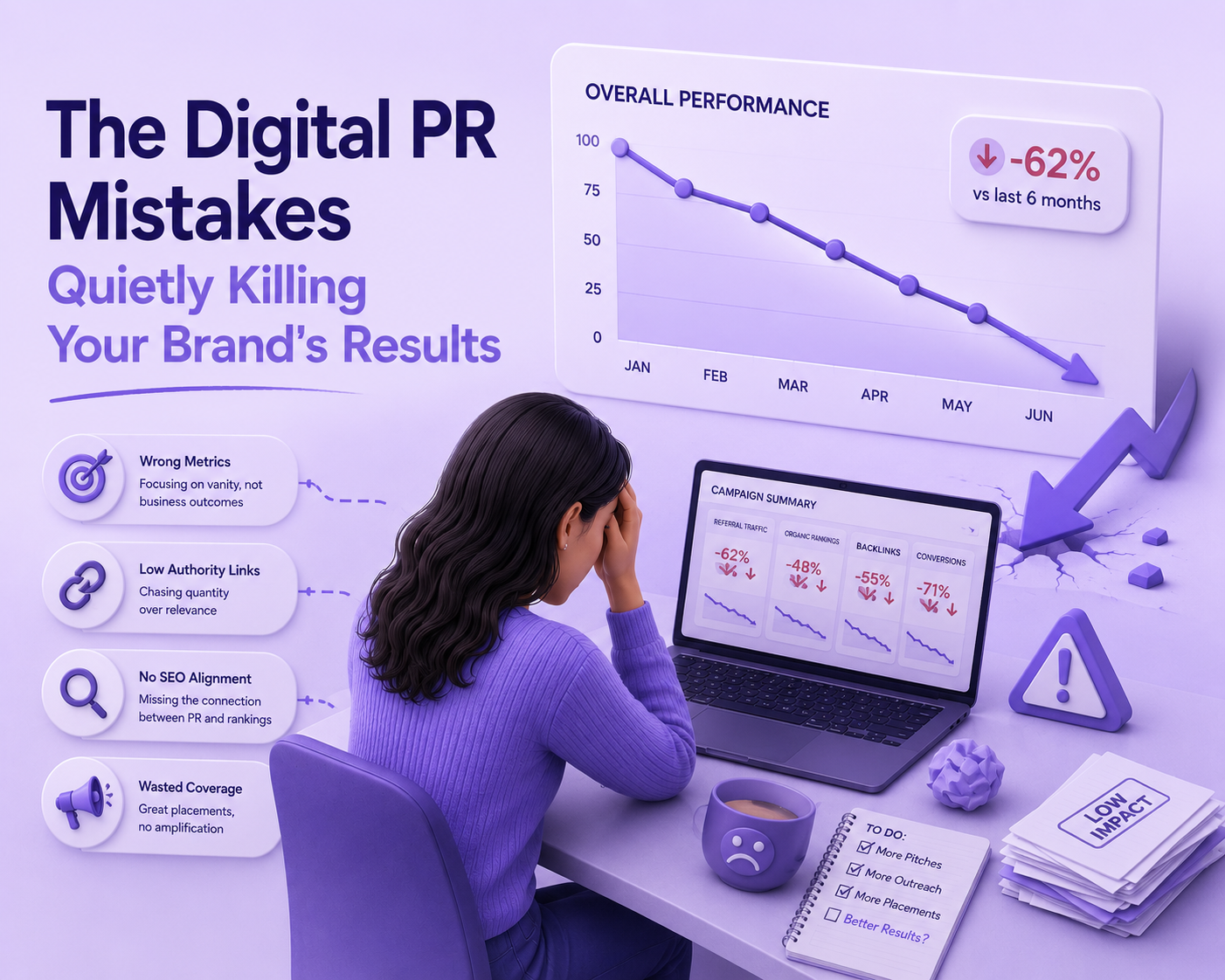
Most digital PR mistakes look like a coverage report with a healthy number of placements, a rising follower count, or a dashboard that's green across the board. Nothing crashes. Nothing gets flagged. The campaign just quietly stops producing traffic, rankings, or revenue - and because nothing is visibly broken, most teams keep doing the same thing, only harder.
I’ve been in digital PR since 2018 and have successfully built the Digital PR Agency by avoiding the major mistakes most make in this field. Below are those exact mistakes I see most often - what they look like from the outside, why they stay hidden, and what to check instead.
1. Chasing Coverage Volume Instead of Relevant Authority
What it looks like: A press list of hundreds of contacts, a generic press release sent to all of them, and a monthly report that leads with "we secured 40 placements this month."
Why it's quiet: Coverage count is the easiest number to report and the easiest one to feel good about. Forty low-tier links from sites your audience never visits will always look better on a slide than four placements in outlets that help business, so volume keeps being chased even when it no longer correlates with results.
Digital PR has a specific advantage here that traditional PR doesn't: you can check, link by link, whether a placement is pulling weight for SEO - and most teams simply never do that.
How to fix it: Build a tight, relevant media list instead of a broad one, and judge a placement by whether the outlet's readership overlaps with your customers, not by its domain authority alone. We've found this matters even more in competitive, regulated verticals - on our igaming digital PR work, for example, a handful of placements in outlets the audience actually trusts consistently outperforms a wide, generic spray, which is one of the patterns we walk through in our casino case study. If you're unclear on how digital PR actually generates links versus just mentions, this breakdown of the mechanics is worth reading before you set your next media list.
2. Measuring Vanity Metrics Instead of Business Outcomes
What it looks like: Reporting built around impressions, reach, coverage count, or Advertising Value Equivalency (AVE) - numbers that go up reliably and feel like proof the campaign is working.
Why it's quiet: This is the mistake that hides every other mistake on this list. If you're watching impressions, a campaign that produces zero referral traffic and zero qualified leads can still look like a win. The gap only shows up when someone asks a harder question: did this help the brand search volume, organic rankings, or pipeline? Most reports never ask it, because the softer metrics are more flattering and easier to hit.
How to fix it: Track referral traffic, brand search lift, keyword movement, and lead quality alongside coverage - not instead of it, but as the numbers that decide whether the campaign continues.
I've written a full breakdown of how to properly measure a digital PR campaign, and it's worth pairing it with a look at the current digital PR tools that make this kind of attribution possible without a spreadsheet nightmare.
3. Treating Digital PR and SEO as Separate Workstreams
What it looks like: A PR team pitching stories with no keyword research behind them, links landing on pages that were never built to rank, and no one checking whether a placement supports a search or AI-visibility goal versus just "getting the brand out there."
Why it's quiet: The coverage still happens. The brand still gets mentioned. It just never compounds into organic growth, because nobody connected the dots between what journalists were willing to cover and what your site needed to rank for. This requires SEO and PR people to talk to each other before a pitch goes out.
How to fix it: Build PR angles around real keyword and topic gaps, and make sure links point to pages designed to convert that traffic. This matters even more now that AI answer engines are a growing source of discovery - you should structure your coverage so it's citable by AI systems and optimize your digital PR for GEO.
We see this play out clearly in regulated industries, like in digital PR for legal services, where every placement needs to map to a specific service page and search intent.
4. Letting Coverage Die on Arrival
What it looks like: A great placement lands, gets shared once on the company LinkedIn, and then disappears. Nobody updates the website, briefs the sales team, or repurposes it into anything else.
Why it's quiet: Getting the coverage feels like the finish line, so it's easy to treat it as the deliverable rather than the raw material. But a placement that never gets amplified is doing maybe 20% of the work it could be doing. This is consistently the single most common gap we find when we audit a new client's past campaigns - the coverage was good, the follow-through never happened.
How to fix it: Build a standing checklist for every placement: share it across owned channels, fold it into sales enablement, add it to the website, and consider repurposing it into additional content. This is really about understanding where digital PR sits relative to earned, paid, and owned media.
5. Sending the Same Generic Pitch to Every Journalist
What it looks like: One press release, one angle, blasted to a list that spans multiple beats and market segments, with no adjustment for what any individual journalist covers.
Why it's quiet: A generic pitch doesn't get you an angry reply - it gets you silence, or occasionally a placement that doesn't really fit. Neither shows up as an obvious failure. It costs compounding: journalists who get pitched irrelevant stories once are less likely to open your next email, and that erosion doesn't show up in any single campaign's report.
How to fix it: Segment your pitching. A story angle that works for a trade publication almost never works unmodified for a national outlet, and vice versa. Spend the extra ten minutes checking what a journalist has written in the last few months before you pitch them - it's a small habit that protects the relationship long after this campaign ends.
6. No Spokesperson or Thought-Leadership Bench
What it looks like: Every piece of outreach routes through generic company statements. There's no individual voice journalists can call on, quote, or come back to.
Why it's quiet: Hiding behind a press release doesn't cost you the current campaign - it costs you the next three. Journalists build a mental shortlist of people who reliably give them something useful, and a brand with no recognizable spokesperson simply isn't on it. This is a slow leak, which is exactly why it's so easy to ignore.
How to fix it: Build two or three credible spokespeople with a real point of view, give them a consistent LinkedIn presence, and prepare commentary in advance so they can react quickly when relevant news breaks. This is also directly tied to how search engines and AI systems evaluate your brand's credibility - see our piece on digital PR’s effect on E-E-A-T for how expert visibility feeds into trust signals well beyond a single article.
7. Newsjacking Without a Real Angle
What it looks like: A quick statement issued the moment a story breaks, restating what's already been reported instead of adding anything new.
Why it's quiet: It feels productive - you reacted fast, you got a quote out, maybe you even landed a mention. But a comment with no real insight rarely earns coverage, and when it does, it doesn't build the kind of credibility that gets you called on again. Speed without substance is easy to mistake for good newsjacking because the activity looks identical from the outside.
How to fix it: Only jump on a trending story if you have a genuine angle - a data point, a counterpoint, or direct experience that adds something a reporter can't get from ten other brands doing the same thing. Digital PR can cut through a crowded news cycle, but only if you have a bigger point to provide.
8. Expecting PR to Behave Like a Paid Channel
What it looks like: Judging a campaign after 4-6 weeks, pulling the budget when there's no immediate spike in sales, and treating digital PR as if it should perform like a paid ad.
Why it's quiet: This one doesn't look like a mistake at all - it looks like fiscal discipline. But digital PR builds compounding assets: backlinks, authority, and brand recognition that keep paying off long after the campaign ends, in a way paid media simply doesn't. Cutting the budget right as the compounding effect starts to show is one of the most common ways we see businesses lose the value of work they've already paid for.
How to fix it: Set expectations before the campaign starts - most meaningful digital PR results take three to six months to show up in traffic and rankings, not weeks. If budget conversations are getting difficult internally, it often helps to separate the immediate-visibility argument from the long-term-authority one - our take on whether digital PR still matters in a zero-click search world is a useful piece to share with anyone on your team who's skeptical of the timeline.
Quick Self-Check: Is Your Digital PR Data Lying to You?
If you're not sure whether your current campaign has one of these problems, this is the fastest way to check:
None of these mistakes announce themselves. They just show up months later as a plateau nobody can quite explain - a strategy that's technically "working" while quietly producing less than it should. The fix, in almost every case, is stopping long enough to check whether the numbers you're watching are the ones that matter.
If you need an expert team to talk to before redesigning your digital PR activities, get in a free strategy call with me, and let’s plan together.
Frequently Asked Questions
What's the difference between a digital PR mistake and a general PR mistake?
General PR mistakes tend to be about messaging, tone, or crisis response. Digital PR mistakes are specifically about the mechanics that connect coverage to search performance - link quality, page targeting, and digital PR-SEO alignment - which don't exist in the same way in traditional PR.
How do you properly measure digital PR ROI?
Move past coverage count and impressions and track referral traffic, brand search lift, organic ranking movement, and lead quality from placements.
Why doesn't more media coverage always mean better SEO results?
Because not every link carries equal weight, and not every placement points to a page built to convert that traffic. Coverage on a relevant, high-authority outlet linking to a strategic page will consistently outperform ten generic mentions with no targeting behind them - see how digital PR builds backlinks for the mechanics.
How long should you give a digital PR campaign before judging results?
Plan for a minimum of three to six months. Early placements can happen within weeks, but the SEO and authority effects that make digital PR valuable compound over time rather than appearing immediately.
What should you do with coverage after you land it?
Treat it as raw material and push it into owned channels, sales enablement, and website content. This single step is where we see the most value left on the table across almost every audit we run.

