


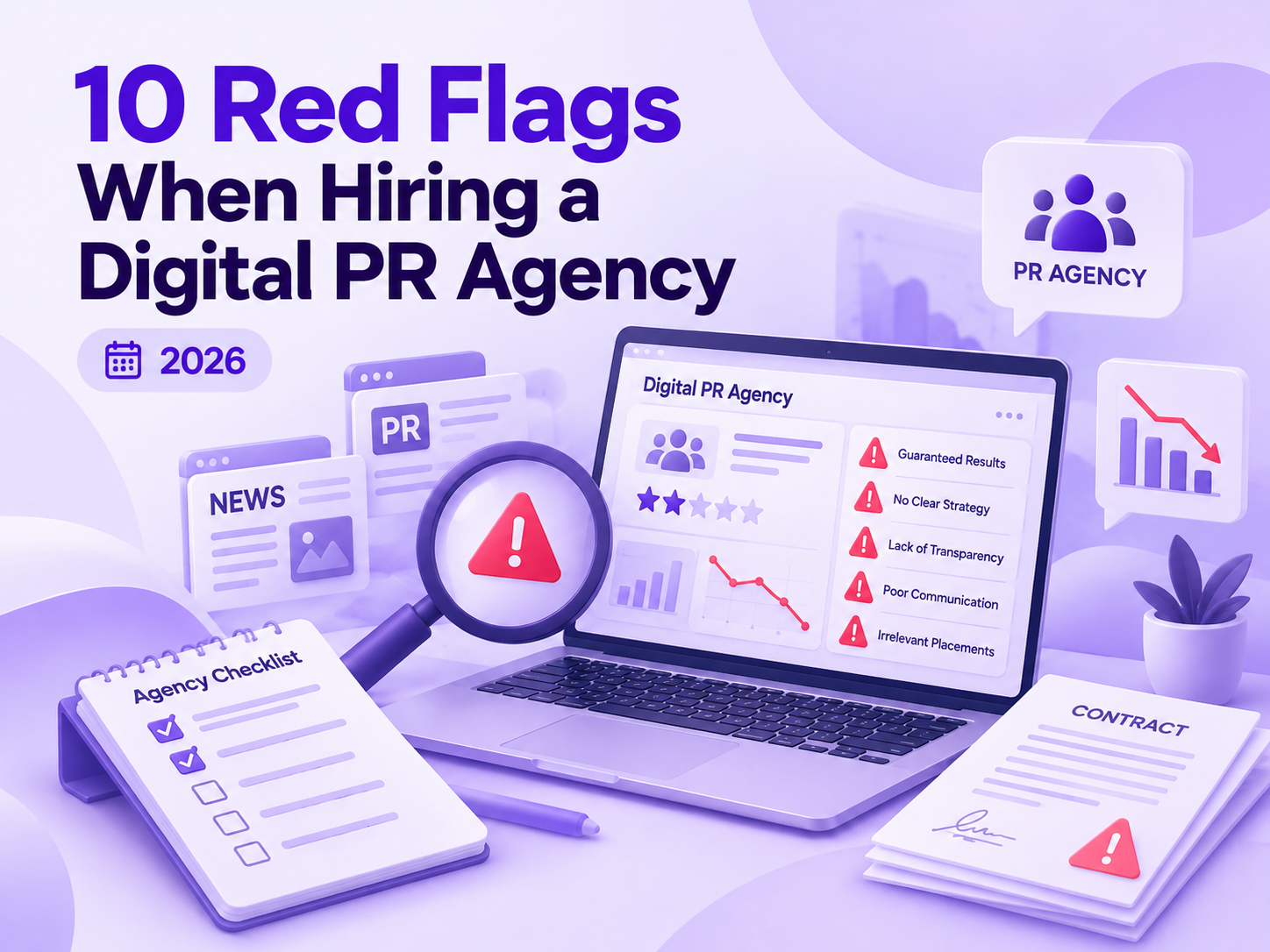
The biggest red flags when hiring a digital PR agency are 100% guaranteed features in named publications, secret link-building methods, guaranteed AI rankings with no method behind them, case studies or experts you can't verify, mass AI-written pitches, campaigns with no link to your goals, reports that show reach but no results, vague pricing, a senior pitch followed by junior delivery, and contracts that lock you in.
We run a digital PR agency, so we know what the standards you should hold agencies to. Every flag below comes with what it looks like in a sales call, why it matters in 2026, and one question that exposes it. If you're new to the topic, start with what digital PR is and come back.
The 10 Red Flags When Hiring a Digital PR Agency at a Glance
1. They Promise a 100% Guaranteed Feature in a Named Outlet
An agency that guarantees you a feature in Forbes or The Wall Street Journal for a fixed fee is usually selling paid, sponsored, or fake placements. Independent editors decide what they publish, so no agency can promise a specific outlet will run your story.
In October 2026, Press Gazette reported that a PR agency selling guaranteed placements was linked to fake overseas editions of Forbes, including "Forbes Scotland" and "Forbes Bahrain", filled with promotional content. Forbes confirmed those sites aren't its own. The agency's sales materials promised articles with no sponsorship labels.
There's an SEO problem too. Google's spam policies treat paid articles and advertorials with links that pass ranking credit as link spam, unless the links are marked rel="sponsored" or rel="nofollow". Google's chief scientist for Search restated the principle plainly: a site can't pay to improve its ranking. So a paid placement is either labeled and passes no ranking credit, or it isn't labeled, and you carry the risk.
A good agency can commit to the quality and relevance of the coverage instead. We commit to a number of earned links from high-authority sites that fit your topic, with clear thresholds (for example, links at DR 70+ and from sites with 1M+ monthly traffic), and we keep working until they're delivered. The outlets we list on our site show where we've earned coverage for clients before. Which editor says yes always depends on the story. The difference between bought and earned coverage matters in all the cases.
Ask them: "Is any coverage you're promising paid, sponsored, or published through a contributor program?"
2. They Won't Explain How They Get Links
If an agency can't show you the pitch, the journalist, and the live article behind each link, assume the links are bought, swapped, or sitting on sites that exist to sell them.
This is a common thread in agencies now. In August 2026, Prism News suspended a network of 200+ AI-generated "local news" sites after investigations exposed plagiarism and fake bylines.
Google's link spam policy also lists buying links, excessive link exchanges, and automated link building as violations. Syndication on its own is normal: a story picked up by one newspaper often runs across its sister titles. The warning sign is paid syndication, such as press release distribution sold as earned coverage.
So, before you trust any placement, run three checks:
- Does the outlet have a masthead with real, named editors?
- Does the byline belong to a journalist with a real history of articles?
- Has the site changed owners recently, or started publishing casino or crypto content out of nowhere?
Real digital PR earns a link because a journalist chose to cite your data or your expert, which in turn help digital PR build backlinks.
Ask them: "Show me five recent placements and the journalist who wrote each one."
3. They Guarantee You'll Rank #1 in ChatGPT, With No Method Behind It
Earning AI citations for specific buyer prompts is a real service and a growing part of digital PR. The red flag is a promise of a fixed position or a permanent mention, proven with a single screenshot, with no agreed prompt list, no baseline, and no explanation of how the coverage will get you there.
Fixed positions can't be promised because AI answers shift from run to run. In a SparkToro and Gumshoe.ai study published in January 2026, 600 volunteers ran 12 prompts nearly 3,000 times across ChatGPT, Claude, and Google's AI. The same list of brands appeared in fewer than 1 in 100 runs. AirOps analyzed 45,000+ citations across 800 queries and found only 1 in 5 brands stayed visible from the first run to the fifth.
A credible AI citation campaign looks different. Target prompts are agreed with you upfront, based on how your buyers ask. The agency audits which sources AI tools cite for those prompts today, earns coverage in those sources, and tracks your citation share across repeated runs. That's how we run AI citation campaigns. Our guide to digital PR for GEO covers the method, and digital PR in a zero-click search world explains why it matters.
Ask them: "Which prompts will you target, how will you measure them, and what's my baseline today?"
4. You Can't Verify Their Case studies, Clients, or Experts
Proof you can't check isn't proof. Logo walls with no coverage behind them, "it's all under NDA," and spokespeople with no real footprint are all warning signs.
Fake experts are now a documented industry problem. In July 2026, Press Gazette reported that Qwoted, a US platform connecting journalists with sources, had banned hundreds of PR agencies, executives and "experts" who appeared not to exist, used AI to write, or commented far outside their field. One banned "finance expert" had been quoted by CBS News, the New York Post and Business Insider. Press Gazette notes these fake experts exist mainly to win links from trusted news sites. If a journalist later pulls the quote, the link goes with it, and your brand is tied to the fake.
The same applies to testimonials. The FTC's rule on reviews and testimonials bans fake ones, including AI-generated reviews, and lets the agency seek civil penalties from knowing violators.
Checkable proof looks something like this. Our case studies show screenshots of the published coverage, the outlets with their domain ratings, and the results for the period we describe, for real companies you can look up yourself. The Spartacus law firm case study, for example, lists 35 backlinks with an average DR of 77, from the Miami Herald and Sacramento Bee to Yahoo News and MSN. Hold every agency to that standard. Real, named experts and verifiable coverage are also exactly the trust signals behind E-E-A-T.
Ask them: "Can I see the coverage behind this case study, and check the client and the results myself?"
5. They pitch at volume with AI-Written Emails
An agency that brags about how many journalists it emails, or fully automates the writing, is burning the media relationships you're paying it to use.
Journalists have said so in numbers. Only about 1 in 10 AI-generated pitches was selected, against roughly 1 in 3 human-written ones, and 35% of journalists switched on a filter that blocks AI pitches entirely.
AI isn't the problem by itself. We use digital PR tools to research journalists faster. The red flag is automated writing and one generic pitch blasted to everyone.
Ask them: "Who writes each pitch, and how do you build the media list for my campaign?"
6. Their Campaign Ideas Have No Link to Your Goals
A campaign topic doesn't have to be your product, but it does have to reach your audience or support the pages you want to rank. The red flag is a viral idea the agency can't connect to either.
A good campaign starts from your commercial goal and works backward. For Kaiia, a fashion ecommerce brand, we ranked royals by how much people copy their style, using Google search volume, TikTok, YouTube and photo data. Cosmopolitan, Marie Claire, and Parade picked up the surprise winner, Prince William ahead of Diana and Kate, with 26 links across the US, UK, France, Italy, and Taiwan. The topic was fashion, so the coverage reached fashion buyers.
Adjacent topics are often the right call. In restricted niches like digital PR for iGaming, adult, or legal, journalists rarely cover the product itself, so a strong campaign picks a topic your audience already cares about. That works when the agency can explain the bridge: who the coverage reaches, why that audience matters to you, and which pages the links support.
Ask them: "Who will this campaign reach, and which of my pages will the links support?"
7. They Report Reach and Media Value, But No Results
Reach, domain rating, and media value are useful context. The red flag is when that's all you get, with nothing tied to your rankings, traffic, leads, or AI visibility.
Watch for reports where the big numbers stand alone: "potential reach" in the billions with no traffic data, a list of placements with no target pages, or a media-value figure with no ranking movement next to it. Reach-only reporting is a habit carried over from traditional PR to digital one. Digital coverage can be measured far more precisely, so expect more.
Before work starts, agree in writing on what counts as a qualified placement. Then expect monthly reporting on links to your target pages, ranking movement, referral traffic, leads, and AI citation share. Our guide on measuring a digital PR campaign lists the metrics that matter.
Ask them: "What counts as a qualified placement, and what will my monthly report show?"
8. Their Pricing Is Vague
If you can't tell what your monthly fee buys, how the links are earned, or what happens when targets are missed, you can't judge whether the price is fair.
Price on its own tells you little. Agencies price by hours, campaigns, or links, and the same budget can buy very different work. What matters is that the offer states the deliverables, the quality bar, and the method.
Other warning signs:
- Packages named "Silver" or "Gold" with no stated deliverables
- Invoices that arrive in months with zero placements and no explanation
- Surprise fees for "premium outlets" or "rush placement"
We publish our pricing openly: plans start at $1,300 a month for 5 links, with set quality thresholds (all DR 30+, two at DR 70+), a 3-month minimum, and a promise to keep working at no extra cost if we miss the target. You don't have to price it like us, but you should be able to read any agency's offer and know exactly what you're paying for.
Ask them: "What exactly does my budget buy each month, and what happens if you miss the target?"
9. A Senior Team Pitches, a Junior Team Delivers
The strategist who wins your business is often not the person who writes your pitches, and in digital PR the pitch decides everything. Reactive opportunities close within hours, and a junior team without editor relationships often misses them. You'll also notice slow replies, missed check-ins, and monthly reports that are copy-pasted from the month before with new numbers.
At Pressora, the senior lead you will be introduced to runs your account, and our reactive pitches go out within hours of a story breaking. Whatever the agency, you should know who that person is before you sign.
Ask them: "Who runs my account day to day, how many accounts do they handle, and can I meet them now?"
10. The Contract Protects Them, Not You
Contract length alone isn't the red flag, since digital PR needs a few months to compound. The red flag is a long term with no performance exit, no approval rights, and no ownership of what you paid for.
Read the contract for these four problems:
- No exit clause or performance benchmarks, even after a long minimum term
- No sign-off on campaign ideas or pitch angles before they go out under your name
- No ownership of the research, data, and content you paid for
- Pressure tactics, like a price that "ends Friday" or trash-talking other agencies instead of showing results
Our clients approve every campaign idea and the final content before any journalist sees it. That's a reasonable standard to ask of anyone.
Ask them: "What's the exit clause, what do I approve before it goes out, and what do I own at the end?"
How to Check a Digital PR Agency for Red Flags Before You Sign
You can vet most agencies in under an hour. Do these five things before the contract call:
- Open five of their recent placements. Check the outlet's masthead, the journalist's byline history, and whether the link is marked sponsored.
- Search their spokespeople and case study clients. Real people have a work history, a LinkedIn trail, and other coverage.
- Ask for a sample monthly report with the client's name removed, and see whether it separates links from mentions.
- Read the contract for three clauses: the exit terms, your approval rights, and who owns the research and content.
- Ask what they refuse to do. A good agency names the tactics it won't touch, like paid links, guaranteed outlets, or invented experts.
If an agency trips two or more of these red flags, keep looking. The right partner will be glad you asked.
Want to test these questions on us? Book a 30-minute call, ask every one of them, and get a free strategy for your business at the end.
Frequently Asked Questions
How much does a digital PR agency cost in 2026?
Most digital PR programs cost $5,000 to $15,000 a month. BuzzStream's 2026 State of Digital PR survey puts the average retainer at $5,458 a month.
How long does digital PR take to show results?
First placements usually go live within 2 to 4 weeks. Ranking changes take longer, typically 2 to 3 months after the first links land, because Google needs time to crawl and weigh them. Reactive campaigns tied to breaking news tend to land faster than original data studies, which need research and design before outreach starts.
Is pay-per-link pricing better than a monthly retainer?
It depends on what you want. Pay-per-link ties cost to output, but it can push agencies toward easier, weaker sites to hit numbers. A retainer funds the research and relationships behind bigger stories, but only works if deliverables are written down. About 90% of agencies default to retainers, according to our pricing research. A retainer with a committed link target gives you both.
Does a digital PR agency need experience in my industry?
It matters most in regulated or sensitive niches, where compliance rules and specialist journalists shape what can be pitched. That's why we run dedicated programs for law firms, iGaming, SaaS and technology digital PR, and adult brands. In most other industries, finding a newsworthy angle matters more than a matching logo.
What should I do if my current agency already shows these red flags?
Ask for a full list of live placements and access to every report. Request a written 30-day plan to fix the issues. Then have someone independent audit the links you've gained for paid or low-quality sites. If the plan is vague or the audit turns up bought links, start your exit and find a new partner before your renewal date.
Can a digital PR agency work alongside my SEO agency or in-house team?
Yes, and it should. Agree on target pages and keywords at the start, share reporting, and decide who owns on-page fixes. Digital PR builds authority, while SEO ensures the pages it points to can rank. If you manage several brands, our guide to link building for multi-brand portfolios covers how to split coverage without diluting authority.

