



.png)
To integrate digital PR into your marketing strategy, tie every PR campaign to a marketing goal, build stories around the topics and pages your SEO team wants to rank, and reuse the coverage in your content, paid, social, and sales work. Then measure it all in one shared scorecard.
Most brands do the opposite. They run PR on its own calendar, completely independent, and the coverage it earns sits in a monthly report nobody outside the PR team reads. That is the silo this guide gets rid of.
Here is the framework we use at our digital PR agency with our clients:
- Start with positioning and business goals
- Align digital PR with your SEO plan
- Build one target list from backlink gaps and AI citations
- Put proactive and reactive PR on the marketing calendar
- Turn coverage into content, social and email
- Use PR in paid media and sales
- Measure everything in one shared scorecard
If you need a refresher on the basics first, start with what digital PR is and how it differs from traditional PR. Otherwise, let's get into it.
Why Digital PR Can't Run in a Silo in 2026
Digital PR is now the one channel that feeds your rankings, your brand, and your visibility in AI answers at the same time. Three shifts this year make that hard to ignore.
AI answers are built on earned media. Muck Rack's May 2026 study found that earned media makes up 84% of the sources ChatGPT, Claude, and Gemini cite. Paid and advertorial content made up just 0.3%. You can't buy your way into the answer. You have to be written about.
Organic clicks are shrinking. Chartbeat measured a 40.2% drop in Google Search traffic to publishers through July 2026, almost double the drop the year before. This means that when fewer people click, being named inside the answer matters more than ranking under it.
Budgets are tilting to paid, and brand is losing the argument. In Gartner's 2026 CMO Spend Survey, paid media rose to 31.4% of the marketing budget. A separate Gartner survey found that most companies are stuck in a "brand doom loop": they underinvest in measuring brand, don't trust the results, and so get even less budget for it.
Put those together, and the case writes itself. PR that is wired into SEO, content, and paid gets measured, gets budget, and compounds. PR that runs on its own gets cut first.
Step 1: Start with Positioning and Business Goals
Before you pitch a single journalist, decide what you want to be known for and which marketing goal each campaign serves.
Choose Two or Three Things You Want to Be Known For
These are your positioning statements: short, specific claims you want journalists, buyers, and AI tools to repeat about you. "The most accurate payroll data for remote teams." "The law firm Texas drivers call after a crash." Every campaign should reinforce at least one of them.
AI tools describe your brand using what other sites say about you. If your coverage tells five different stories, the AI answer will be vague. If it tells one story five times, that story becomes how you are described. It is how digital PR builds your brand over time.
Map Each PR Goal to a Marketing Goal
Digital PR can serve several goals, but each campaign should have one primary job. Use this table to agree on that job with the rest of the marketing team:
In our experience, the campaigns that disappoint are almost always the ones where nobody agreed on that one job up front. The SEO team expected links to the product page, the brand team expected a national headline, and the campaign was built for neither.
Step 2: Align Digital PR with Your SEO Plan
Your PR team should be building stories around the topics your SEO team wants to rank for, and pointing the coverage at the pages that need authority. Your digital PR should support your SEO.
Build Campaigns Around Target Topics
Ask your SEO team for their priority topic clusters and the pages behind them. Then find the story inside each topic: a ranking, an index, a survey finding, or a counterintuitive data point a journalist would want to run.
We did it for a digital business card platform we work with. The brand wanted to be part of the remote work conversation, one of the most searched topics in the US. It was a key in their SEO plan. Most coverage was generic productivity tips, so we built a data-led ranking of the best US cities for remote workers, scoring 40 cities on nine factors, including internet speed, salary, rent, and safety.
The winner was Frisco, Texas, not San Francisco or New York! That surprise was the headline. The campaign earned 36 backlinks from editorial coverage, with links between DR 54 and DR 94, mostly in the DR 70 to 86 range, including Yahoo News, MSN, the Miami Herald, and more than 20 regional outlets.
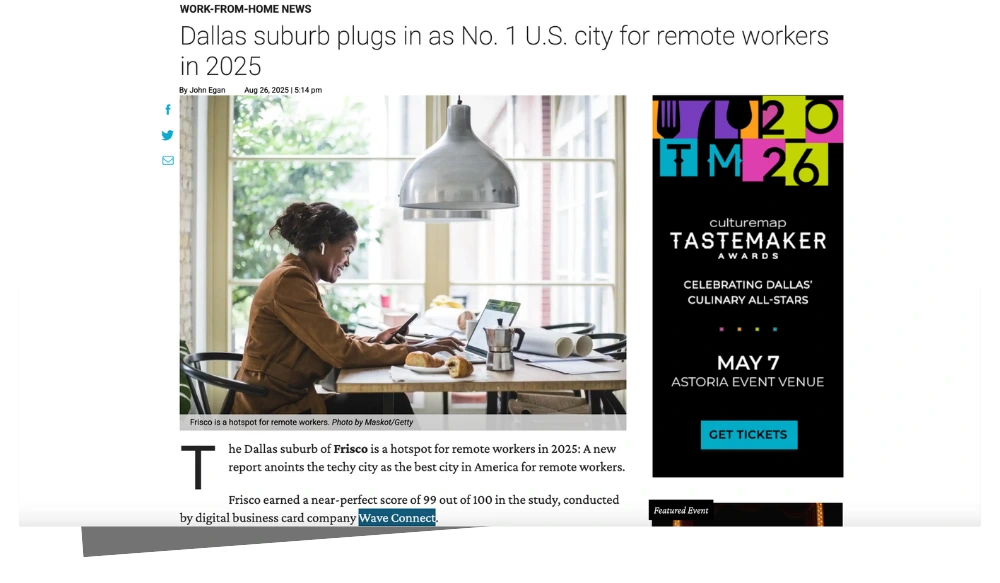
We chose the topic because the brand's buyers were already searching for it, so it had high SEO value. Because the data covered 40 cities, regional papers got a local angle and national titles got a trend story. One dataset served the SEO goal and the brand goal at once.
Point Coverage at the Pages You Want to Rank
Link building only helps SEO if the links land in the right place. Host the data on a dedicated page with a clear methodology section, and make that page the one journalists cite. Then link from it to your priority product or service pages, so the authority flows where it counts.
Keep anchor text natural. Branded and descriptive anchors are safer and more useful than exact-match keywords. Our guide to anchor text best practices in digital PR covers this in detail.
Earn the Links
Google has run four spam updates in 2026. The latest started on September 24 with a rollout window of up to two weeks, longer than any spam update before it this year. Paid link packages dressed up as PR get caught fast.
Editorial links from real coverage are the safe way to connect PR and SEO. If you're unsure where the line is, read about how digital PR builds backlinks.
Step 3: Build One Target List from Backlink Gaps and AI Citations
Your media list should answer two questions: where do the links that help you rank come from, and where do AI tools look when your buyers ask about your category? Those are two different lists, and most brands only build the first one.
Source 1: your competitors' backlink gaps. Pull the referring domains of the two or three competitors who outrank you. Filter for editorial sites that already cover your space, which makes them warmer targets.
Source 2: the outlets AI tools cite. Write down 20 to 25 questions your buyers ask, the kind sales hears on calls. Run them through ChatGPT, Perplexity, Gemini, and Google's AI Mode, and record every source cited. You can do this by hand or with digital PR tools.
When our team runs this exercise for clients, the two lists rarely match. AI tools often lean on trade titles, comparison articles, and niche publications that never show up in a backlink report. Those are usually the cheapest gaps to close. We explain the method in more depth in our guide to digital PR for GEO.
One thing to leave off the list: wire distribution. BuzzStream analyzed 4 million AI citations and found that press releases syndicated through wire services accounted for 0.04% of them. Original editorial coverage made up 81% of the news citations. So, pitch to journalists.
Refresh both lists every quarter. AI sources shift as the models change, and competitors keep earning new links.
Step 4: Put Proactive and Reactive PR on the Marketing Calendar
Digital PR should live on the same calendar as your launches, promotions, and content plan. That way every team knows what story is going out, and when. Run two tracks side by side.
Proactive PR: Campaigns You Plan
These are your data studies, indexes, surveys, and expert reports. Time them to land two to four weeks before the moment you want to own: a product launch, a peak season, a sales push. That gives journalists time to cover it and gives your SEO team time to see the links get picked up.
A strong proactive campaign can also get you into conversations your brand would never be invited to otherwise. For a casino brand in our iGaming digital PR portfolio, we built an AI chatbot reliability study. We scored 10 major chatbots on hallucination rate, user ratings, consistency, and downtime, then gave each a risk score. The finding nobody expected: ChatGPT, the most used tool, ranked least reliable for work, making up information 35% of the time in our scoring.
The study earned 67 links and mentions across more than 10 countries, including CoinMarketCap, NewsBreak, and Teslarati; backlinks from LinkedIn; and a share from Elon Musk on X. A gambling brand rarely gets into tech and business media. Riding the biggest topic of the year with real data got it there.
Reactive PR: Commentary on Breaking News
Reactive PR, or newsjacking, means getting your expert quoted while a story is still being written. It works best when it is planned, not improvised:
- Name one or two spokespeople and brief them on the topics they can cover
- Write and approve sample quotes in advance, so legal sign-off doesn't kill your speed
- Set alerts for your category's keywords, regulators, and big competitors
- Aim to send a quote within hours, not days
In Cision's 2026 State of the Media survey, 72% of journalists said fewer than a quarter of the pitches they get are relevant. Yet 66% said PR materials are one of their top sources of story ideas. So, journalists want your input, as long as it is relevant.
Not sure how to split time between the two? Read reactive PR vs. proactive PR.
Plan Around Your Peak Season
If you sell online, your Q4 PR window is closing. Adobe forecasts that AI-driven traffic to US retail sites will grow 130% year over year this holiday season. Shoppers are asking AI tools what to buy, and those answers draw on gift guides and product roundups that journalists are writing now. Coverage that lands after Black Friday won't benefit you until next year.
Step 5: Turn Coverage Into Content, Social and Email
A digital PR campaign is a content asset that you can reuse even before outreach starts. One data study can become:
- A pillar page on your site with the full data, a methodology section, and charts. This is the page journalists link to, and AI tools quote.
- Three to five LinkedIn posts from your spokesperson, each built around one finding
- A newsletter feature for customers and prospects
- A short video or carousel walking through the headline numbers
- An "As featured in" block on your homepage and key landing pages
- A yearly update. Refresh the data each year, and you have a reason to pitch the same journalists again
The yearly refresh is underrated. Journalists who covered your first study are the easiest ones to pitch the second time. Each new edition also adds a fresh round of links to the same page, which keeps building its authority.
This also feeds the digital PR E-E-A-T signals Google looks for. Your expert's name appears in the press, on your site, and on LinkedIn, all saying consistent things.
Step 6: Use Digital PR in Paid Media and Sales
Coverage gives your ads and sales team something they can't create themselves: third-party proof. That is the core advantage of earned media over paid and owned media.
For paid media:
- Add press logos and short quotes to paid landing pages.
- Retarget visitors to your data study page. They already care about the topic.
- Track branded search. Good coverage lifts it, and clicks on your own name are cheap.
AI platforms now sell ads too. OpenAI launched ads in ChatGPT this year, shown beside its answers. The answer itself is still built from earned media, so ads get you next to it and coverage gets you into it.
For sales:
- Send every new placement to sales with one line on how to use it.
- Turn data studies into collateral and outreach openers.
- Ask sales which objections come up most, and build your next campaign around one.
This matters most in long B2B sales cycles, where buyers check what third parties say before they commit. It's central to how we run SaaS digital PR and law firm digital PR.
Step 7: Measure Digital PR in One Shared Scorecard
Put PR metrics in the same dashboard your SEO and marketing teams already use, broken into four layers:
Use Google's New AI Performance Report
As of August 31, 2026, Google's generative AI performance report in Search Console is available to every site worldwide. It shows how often your pages appear in AI Overviews and AI Mode, by page, country, and date.
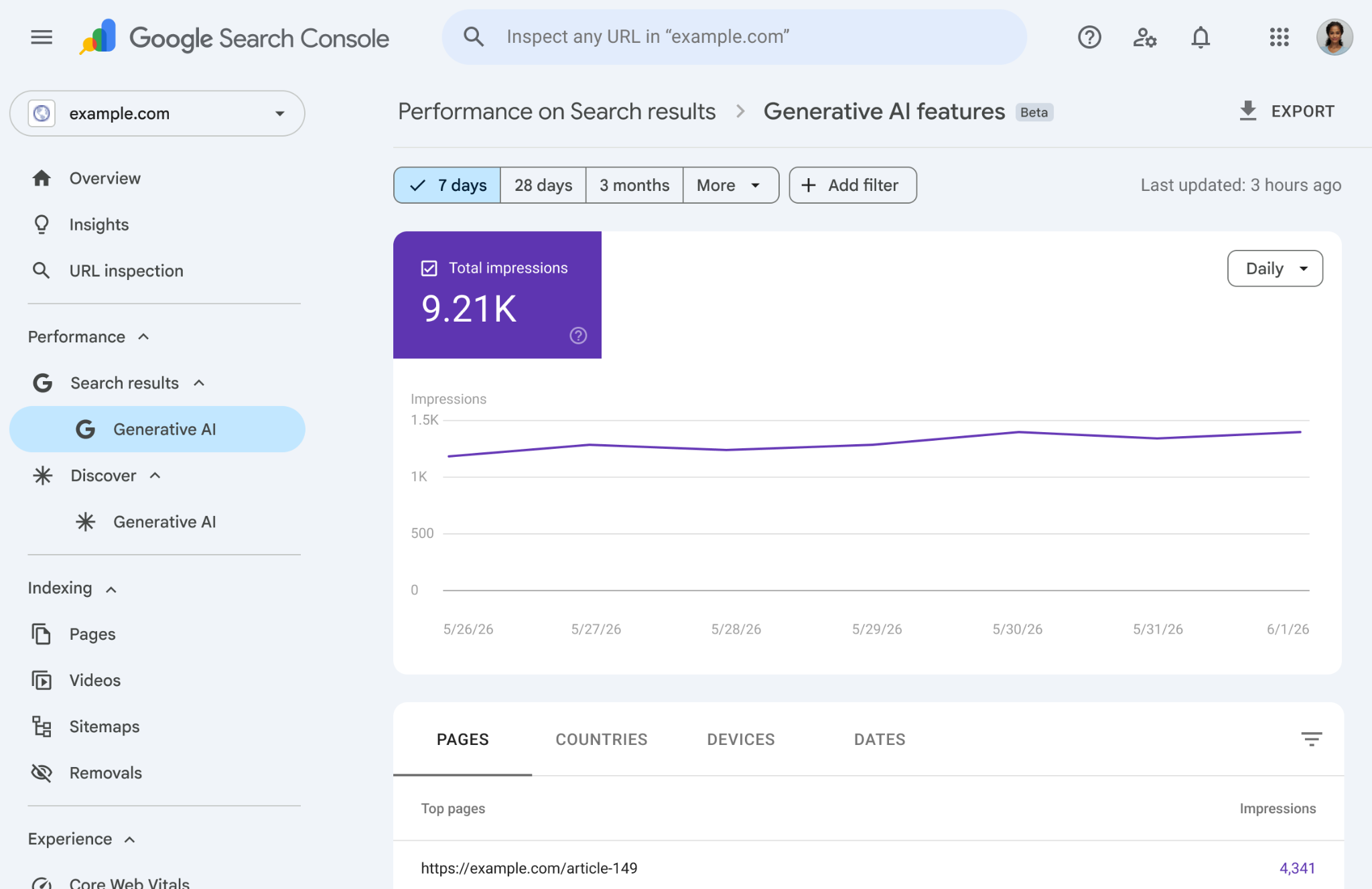
It shows impressions only, with no clicks or queries, so it won't tell you everything. But it is the first free, first-party view of your AI visibility on Google.
Watch the pages your PR campaigns point to: if AI impressions on those pages climb after coverage lands, that is your best sign you have that PR is feeding AI search. For ChatGPT and Perplexity, keep tracking your 20 to 25 buyer prompts each month.
Check the AI Opt-Out Setting
The same rollout added a Search Console setting that removes your whole site from AI Overviews and AI Mode. Google says it doesn't affect regular rankings. But if someone on your team switches it on, all the PR work aimed at AI visibility on Google stops counting. Check it, and agree on who owns that decision.
Set a Review Rhythm
- Monthly: coverage earned, ranking changes on target pages, AI impressions
- Quarterly: business impact against cost, plus a refresh of your target list and topics
Be patient with the search layer. First placements usually go live within a few weeks, but ranking changes take two to three months to show. For the full framework, read how to measure your digital PR campaign.
Who Owns What: How Each Team Works With Digital PR
Integration only works if every team knows what it gives PR and what it gets back. Use this table as a starting point for your own setup:
One person should own the calendar and the scorecard. That can be an in-house PR lead or an agency, but someone has to make sure the work moves between teams. If you're deciding which way to go, our team at Pressora runs this hand-off for clients every month, and we're happy to walk you through how it works.
Bringing It Together
Integrating digital PR into your marketing strategy comes down to a few habits: one set of goals, one calendar, one target list, and one scorecard shared across PR, SEO, content, paid, and sales. Do that, and every placement works for your rankings, your AI visibility, and your pipeline at once.
Want to see where you stand today? Pressora runs a free citation audit across ChatGPT, Perplexity, and Google AI Overviews before every strategy call, so you'll know which outlets your buyers' AI answers rely on and where your competitors are already showing up. Sign up for a free call and let’s reach your goals together.
Frequently Asked Questions
Can I add digital PR if I already work with a traditional PR agency?
Yes. Split the scope: the traditional agency handles corporate news, crisis comms, and broadcast, while digital PR runs campaigns built for links, search, and AI visibility. Share one media calendar so the two teams never pitch the same journalist in the same week.
Should digital PR be handled in-house or by an agency?
In-house teams know the product best; agencies bring journalist relationships, data research, and outreach capacity. Many brands run a hybrid, with an in-house lead who owns strategy and an agency that runs campaigns. We compare costs and trade-offs in digital PR agency vs. in-house team.
How much does digital PR cost?
It depends on your goals and how competitive your niche is. At Pressora, plans start at $1,300 a month for five guaranteed editorial backlinks and go up to $3,600 for fifteen, with a three-month minimum.
Is digital PR only for big brands?
No. Smaller brands often see faster gains because each placement moves a smaller authority profile further. What matters is having a story journalists want: original data, a credible expert, or a fresh angle on a topic your buyers care about.
Does digital PR work in regulated or restricted industries?
Yes, but the playbook changes. iGaming, adult, and legal brands face stricter editorial filters and compliance rules, so campaigns need angles that clear them. We run dedicated programs for all.
How do you run digital PR across multiple brands?
Give each brand its own positioning and topics, so campaigns don't compete for the same journalists and keywords. Then share data, tools, and reporting across the portfolio. Our guide to link building for multi-brand portfolios covers how to scale without diluting authority.

